
- Healthcare Diagnostics as a Stable and Growing Career Field
- What Is Diploma in Medical Lab. Technology (DMLT)?
- Understanding the Core Curriculum of DMLT
- Key Technical, Diagnostic, and Industry Skills You Gain
- Career Paths after Diploma in Medical Lab. Technology
- Top Job Roles in Diagnostic Laboratories and Hospitals
- Opportunities in Blood Banks, Pathology Labs, and Research Centers
- Government and Public Sector Jobs after DMLT
- Higher Education and Specialization Options after DMLT
- Exploring Global Opportunities for Medical Lab Technicians
- Conclusion
- Frequently Asked Questions (FAQs)
Healthcare Diagnostics as a Stable and Growing Career Field
The healthcare industry is one of the fastest-growing sectors globally, and diagnostic services form its backbone. From routine blood tests to advanced disease detection, medical laboratories play a crucial role in patient care. This makes DMLT career scope highly promising for students who want to enter the healthcare field quickly with practical skills.
With rising awareness about preventive healthcare, the demand for skilled medical lab technicians is steadily increasing. Diagnostic centers, hospitals, blood banks, and research labs depend on trained professionals to deliver accurate results. The growing medical lab technology job opportunities reflect how essential laboratory services are to modern medicine.
Artificial Intelligence (AI) and automation are also transforming healthcare diagnostics. AI-based lab machines, digital pathology, and automated blood analyzers are enhancing accuracy and speed. However, trained technicians remain indispensable to operate, interpret, and validate results. This blend of technology and human expertise ensures a bright future for paramedical professionals.
Institutions like Lovely Professional University support healthcare education with modern labs, updated curriculum, and practical exposure, helping students build strong foundations for long-term careers.
| Did You Know?
Medical lab technicians contribute to nearly 70% of medical decisions, as doctors rely heavily on lab test results for diagnosis and treatment planning. |
What Is Diploma in Medical Lab. Technology (DMLT)?
The Diploma in Medical Lab. Technology (DMLT) is a paramedical diploma programme designed to train students in laboratory testing and diagnostic procedures. This course prepares students for technical roles in pathology labs, hospitals, and diagnostic centers.
The DMLT programme typically spans 3 years in LPU and includes both theoretical knowledge and hands-on practical training. Students learn how to perform tests on blood, urine, tissues, and other body samples to help diagnose diseases.
This paramedical diploma future is especially attractive for students who want to start working in healthcare without pursuing long-term medical degrees. It provides early entry into the healthcare job market with steady employment opportunities.
Understanding the Core Curriculum of DMLT
The DMLT curriculum is structured to provide foundational and advanced knowledge in medical diagnostics. It includes both classroom learning and lab-based practical sessions.
Major Subjects Covered:
- Clinical Biochemistry
- Hematology
- Microbiology
- Pathology
- Immunology
- Blood Banking Techniques
- Laboratory Management and Ethics
Students also receive training in operating diagnostic equipment, maintaining lab safety standards, and following medical protocols. Many institutions now integrate AI-based diagnostic tools and automated analyzers to align learning with modern healthcare demands.
| Did You Know?
Many advanced laboratories now use AI-assisted systems to detect abnormalities in blood samples within seconds, improving diagnostic accuracy. |
Key Technical, Diagnostic, and Industry Skills You Gain
A Diploma Medical Lab. Technology DMLT Course equips students with a combination of technical precision, analytical thinking, and patient-care sensitivity.
| Skill Category | Description | Relevance |
| Laboratory Techniques | Blood testing, sample collection, slide preparation | Essential for diagnostic accuracy |
| Diagnostic Skills | Identifying abnormalities in samples | Supports doctors in decision-making |
| Equipment Handling | Operating analyzers and microscopes | Required in modern labs |
| Data Management | Recording and reporting results | Ensures patient safety and compliance |
| AI-Assisted Lab Skills | Using automated diagnostic systems | Prepares for tech-driven healthcare |
These skills make graduates job-ready and capable of working efficiently in high-pressure medical environments.
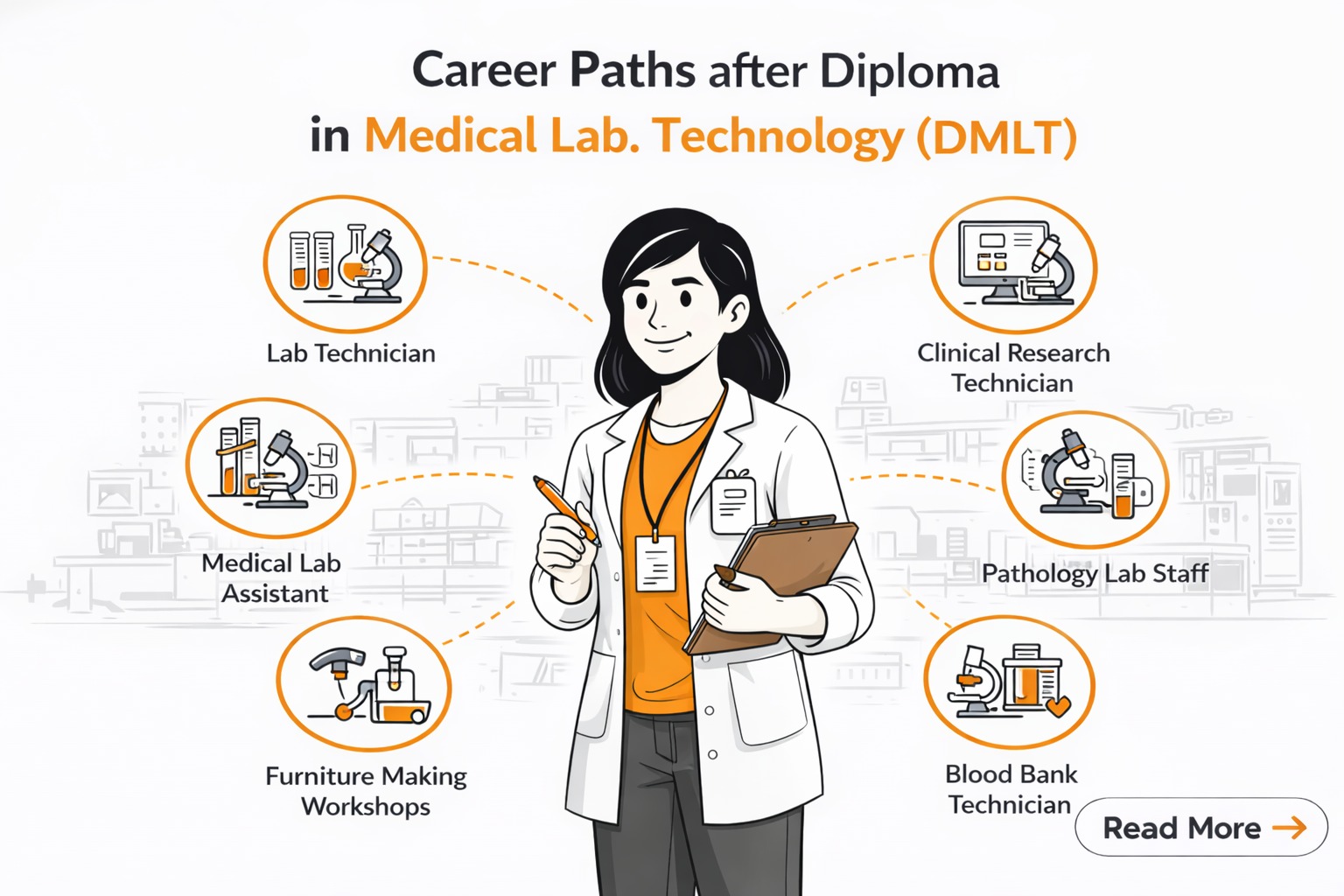
Career Paths after Diploma in Medical Lab. Technology
Graduates can explore diverse roles across the healthcare ecosystem.
Popular Career Options:
- Medical Lab Technician
- Lab Assistant
- Pathology Technician
- Blood Bank Technician
- Research Lab Technician
- Quality Control Technician
- Phlebotomist
- Lab Supervisor (with experience)
The use of AI-powered healthcare career mapping tools helps students identify suitable roles based on skills and market demand trends.
| Did You Know?
With experience and additional certifications, DMLT graduates can advance to supervisory and laboratory management positions. |
Top Job Roles in Diagnostic Laboratories and Hospitals
Diagnostic labs and hospitals are the primary employers of DMLT graduates.
Employment Settings:
- Private Diagnostic Laboratories
- Multi-specialty Hospitals
- Healthcare Clinics
- Research Institutes
- Corporate Healthcare Companies
Major diagnostic chains such as Dr. Lal PathLabs, Thyrocare, and Metropolis Healthcare regularly recruit skilled technicians.
Roles include conducting tests, maintaining lab equipment, preparing reports, and ensuring quality control in sample processing.
Opportunities in Blood Banks, Pathology Labs, and Research Centers
Blood banks and pathology labs require trained professionals to manage blood grouping, cross-matching, and storage procedures.
Technicians also assist in disease detection, histopathology analysis, and microbiological studies. Research laboratories provide opportunities in clinical trials and medical innovations.
The scope in pathology lab careers continues to grow with increased awareness of preventive healthcare and disease screening programmes.
| Did You Know?
Blood bank technicians play a critical role in emergency surgeries by ensuring safe and compatible blood transfusions. |
Government and Public Sector Jobs after DMLT
Government hospitals and public health departments offer stable employment opportunities for DMLT graduates.
Employment Areas:
- Government Hospitals
- Public Health Departments
- Military Medical Services
- Railways Healthcare Units
- Municipal Health Centers
Public sector healthcare careers provide job security, structured growth, and benefits. Many state and central government recruitment boards conduct exams for paramedical positions.
Higher Education and Specialization Options after DMLT
Students wishing to continue their education can pursue:
- B.Sc. in Medical Laboratory Technology
- B.Sc. in Clinical Laboratory Science
- Specialized certifications in Microbiology or Pathology
- Hospital Administration Courses
Higher studies after DMLT enhance salary prospects and open managerial roles in diagnostics. AI-guided education pathways now help students choose suitable specializations based on career goals.
| Did You Know?
Completing a B.Sc. after DMLT can significantly increase earning potential and leadership opportunities in laboratory settings. |
Exploring Global Opportunities for Medical Lab Technicians
Healthcare is a global necessity, and medical lab technicians are in demand worldwide.
Countries in the Middle East, Canada, Australia, and Europe offer opportunities in diagnostic labs and hospitals. International careers for medical lab technicians often require additional certification or licensing exams.
Global healthcare careers provide exposure to advanced technologies, higher salaries, and multicultural work environments.
| Did You Know?
Medical lab technology is recognized internationally, making it easier for skilled professionals to explore overseas job opportunities after meeting certification requirements. |
Conclusion
The career potential after DMLT is strong, stable, and future-ready. As healthcare continues to expand, the need for skilled diagnostic professionals will only grow. From hospitals and diagnostic labs to research centers and global healthcare institutions, DMLT graduates have diverse pathways to explore.
The integration of AI in diagnostics ensures that this field remains technologically advanced while still relying on skilled human professionals. With the right training, practical exposure, and continuous learning, students can build long-term opportunities in medical lab technology and contribute meaningfully to patient care.
Frequently Asked Questions (FAQs)
- What is the career scope after DMLT?
DMLT career scope includes roles in hospitals, diagnostic labs, blood banks, and research centers. Graduates can also pursue higher studies for better growth prospects. - Is DMLT a good career option?
Yes, it offers stable employment, growing demand, and opportunities in both private and government sectors. - Can I pursue higher studies after DMLT?
Yes, students can opt for B.Sc. in Medical Laboratory Technology or specialized certifications. - Are there government jobs after DMLT?
Yes, various government hospitals and public health departments recruit medical lab technicians through competitive exams. - Are global opportunities available after DMLT?
Yes, with additional certifications and licensing, DMLT graduates can explore overseas healthcare careers.



![Career Paths after B.Tech. Biomedical Engineering [Lateral Entry]](https://www.lpu.in/blog/wp-content/uploads/2025/12/Career-Paths-after-B.Tech_.-Biomedical-Engineering-Lateral-Entry-1-100x70.png "Career Paths after B.Tech. Biomedical Engineering [Lateral Entry]")