- The Ever-Evolving World of Computer Science
- What Is M.Tech. Computer Science and Engineering?
- Exploring the Core Areas of Advanced Computing
- Key Technical Skills You Master During the Programme
- Career Paths after M.Tech. Computer Science and Engineering
- Top Job Roles for M.Tech. Computer Science and Engineering Graduates
- Opportunities in Artificial Intelligence, Machine Learning, and Data Science
- Research and Development Careers in Computer Science
- Government and Public Sector Opportunities
- Global Career Options for M.Tech. Computer Science and Engineering Professionals
- Industry Collaborations and Real-World Exposure
- Conclusion
- Frequently Asked Questions (FAQs)
The Ever-Evolving World of Computer Science
An M.Tech. Computer Science and Engineering offers extensive scope by providing advanced knowledge in areas such as artificial intelligence, machine learning, cybersecurity, data science, cloud computing, and high-performance systems, enabling graduates to tackle complex technical challenges and contribute to cutting-edge research.
With the continuous growth of the digital economy, computer science professionals enjoy a wide range of career opportunities, including software development, data analytics, AI engineering, cybersecurity, cloud architecture, DevOps, and academic or research positions in universities and R&D labs.
The tech industry itself is rapidly evolving, shaped by major trends such as the widespread adoption of AI, the expansion of cloud and edge computing, heightened focus on cybersecurity, the rise of blockchain technologies, increased reliance on big data, and emerging fields like quantum computing, IoT, and extended reality.
Together, these advancements ensure that computer science remains one of the most dynamic and opportunity-rich fields, offering strong career prospects and continuous growth for M.Tech. Computer Science and Engineering.
An M.Tech. Computer Science and Engineering offers vast and steadily expanding scope as it equips students with advanced theoretical knowledge and practical expertise in domains such as artificial intelligence, machine learning, cybersecurity, data science, cloud computing, distributed systems, and high-performance computing.
This higher-level specialization enables graduates to design complex algorithms, develop scalable software architectures, enhance system security, and contribute to innovative research that pushes technological boundaries.
With constant innovation reshaping technology and society, M.Tech. Computer Science and Engineering graduates are well-positioned to contribute meaningfully to future advancements and to lead the development of intelligent, secure, and sustainable technological solutions.
As digital transformation accelerates across all sectors, the need for skilled computer scientists is higher than ever, offering diverse and rewarding career paths in both industry and research.
The field of computer science continues to expand at an extraordinary pace, creating immense opportunities for professionals with advanced qualifications like an M.Tech. Computer Science and Engineering.
The programme’s strong foundation in emerging technologies such as AI, machine learning, cloud computing, cybersecurity, and data analytics prepares graduates to meet the evolving demands of the global tech industry.
What Is M.Tech. Computer Science and Engineering ?
M.Tech. Computer Science and Engineering where M.Tech. stands for Master of Technology is a postgraduate engineering degree focused on advanced concepts, technologies, and research areas in computer science.
It is typically pursued after completing a B.Tech., B.E., or an equivalent bachelor’s degree in engineering or computer science.
The programme provides in-depth knowledge of core and emerging fields such as algorithms, advanced programming, artificial intelligence, machine learning, data science, cybersecurity, cloud computing, distributed systems, and high-performance computing.
Unlike basic undergraduate study, M.Tech. Computer Science and Engineering emphasizes specialization, research skills, problem-solving abilities, and innovation, preparing students to work on complex engineering challenges and cutting-edge technological developments.
As a postgraduate engineering programme, M.Tech. Computer Science and Engineering focuses on: Advanced computer systems and architectures, Software engineering principles, Networking, operating systems, and security, Data management and big data technologies, Emerging technologies like AI, IoT, blockchain, and cloud platforms, etc.
M.Tech. Computer Science and Engineering enables students to specialize in various advanced areas, including- Artificial Intelligence and Machine Learning, Data Science & Analytics, Cloud Computing & DevOps, Cybersecurity and Ethical Hacking, Distributed and High-Performance Computing, etc.
This specialization ensures that graduates are equipped with the latest technical skills, making them highly competitive in the global tech industry.
M.Tech. Computer Science and Engineering is a highly valuable postgraduate programme that deepens a student’s expertise in advanced computing concepts, modern technologies, and research-driven problem solving.
By offering specialized knowledge in areas such as artificial intelligence, data science, cybersecurity, cloud computing, and high-performance systems, the programme equips graduates to meet the rapidly evolving demands of the global technology landscape.
As digital innovation continues to reshape industries and create new opportunities, professionals with an M.Tech. Computer Science and Engineering degree are well-prepared to contribute to cutting-edge developments, lead technical projects, and pursue impactful careers in both industry and academia.
Ultimately, the degree strengthens both technical proficiency and research capability, making it a powerful stepping stone toward a successful and future-ready career in computer science and engineering.
Exploring the Core Areas of Advanced Computing
Advanced computing encompasses several foundational and emerging domains that drive modern technological innovation.
At its core, computer networks form the backbone of global communication, enabling data exchange, internet connectivity, cloud services, and secure information transfer across distributed systems.
Equally important are software systems, which include operating systems, compilers, databases, and large-scale software architectures that ensure efficient processing, resource management, and reliable application performance.
Beyond these fundamentals, advanced computing extends into highly specialized fields such as artificial intelligence, machine learning, data science, cybersecurity, distributed and high-performance computing, and cloud-native technologies.
These areas focus on solving complex computational problems, building intelligent systems, analyzing massive datasets, ensuring secure digital environments, and designing scalable infrastructures.
Together, these core domains form the foundation for innovation in fields like automation, robotics, smart devices, and next-generation digital solutions, making advanced computing essential to the evolution of modern technology.
Computer networks, software systems, and advanced computing fields together form the technological foundation that powers today’s digital world.
Computer networks enable seamless communication and data exchange between devices, supporting everything from the internet and cloud platforms to enterprise infrastructures and IoT ecosystems. Software systems, including operating systems, databases, compilers, and large-scale application frameworks, ensure that hardware resources are efficiently managed while enabling reliable, user-friendly, and scalable software solutions.
Building upon these pillars, advanced computing fields such as artificial intelligence, machine learning, data science, cybersecurity, blockchain, distributed computing, and high-performance computing drive innovation by tackling complex problems, automating intelligent decision-making, and enhancing computational efficiency.
Together, these interconnected areas form the backbone of modern technology, enabling the development of smarter applications, secure digital environments, and highly efficient computing solutions across industries.
Key Technical Skills You Master During the Programme
During an M.Tech. Computer Science and Engineering, students develop a strong set of technical skills that are highly relevant in today’s tech industry.
They gain expertise in programming, learning to write efficient, scalable, and optimized code across multiple languages and platforms.
Key Technical Skills in AI, Machine Learning, and Data Analysis
- Programming & Software Development
Proficiency in languages such as Python, Java, C++, and R for algorithm implementation and software engineering. - Data Analysis & Data Engineering
Data cleaning, preprocessing, and visualization to extract meaningful insights from large datasets. - Artificial Intelligence (AI)
Understanding and implementing intelligent algorithms for problem-solving and automation. - Machine Learning (ML)
Implementing supervised, unsupervised, and reinforcement learning algorithms. - Deep Learning & Neural Networks
Building convolutional neural networks (CNNs), recurrent neural networks (RNNs), and transformers for complex tasks like image recognition, speech processing, and NLP.
An M.Tech. Computer Science and Engineering equips students with a comprehensive set of technical skills that are highly relevant in today’s technology-driven world.
By mastering programming, software development, data analysis, artificial intelligence, and machine learning, graduates gain the ability to design intelligent systems, develop scalable software solutions, and extract actionable insights from complex datasets.
These skills not only prepare students to tackle real-world computational challenges but also position them to contribute effectively to cutting-edge innovations across industries such as AI, robotics, cloud computing, finance, healthcare, and more.
Ultimately, the programme ensures that graduates are industry-ready, research-capable, and adaptable, making them valuable contributors to the rapidly evolving field of computer science.
| Did You Know ?
Python, a primary language for AI and ML, has been the fastest-growing programming language for the past several years due to its simplicity and versatility. |
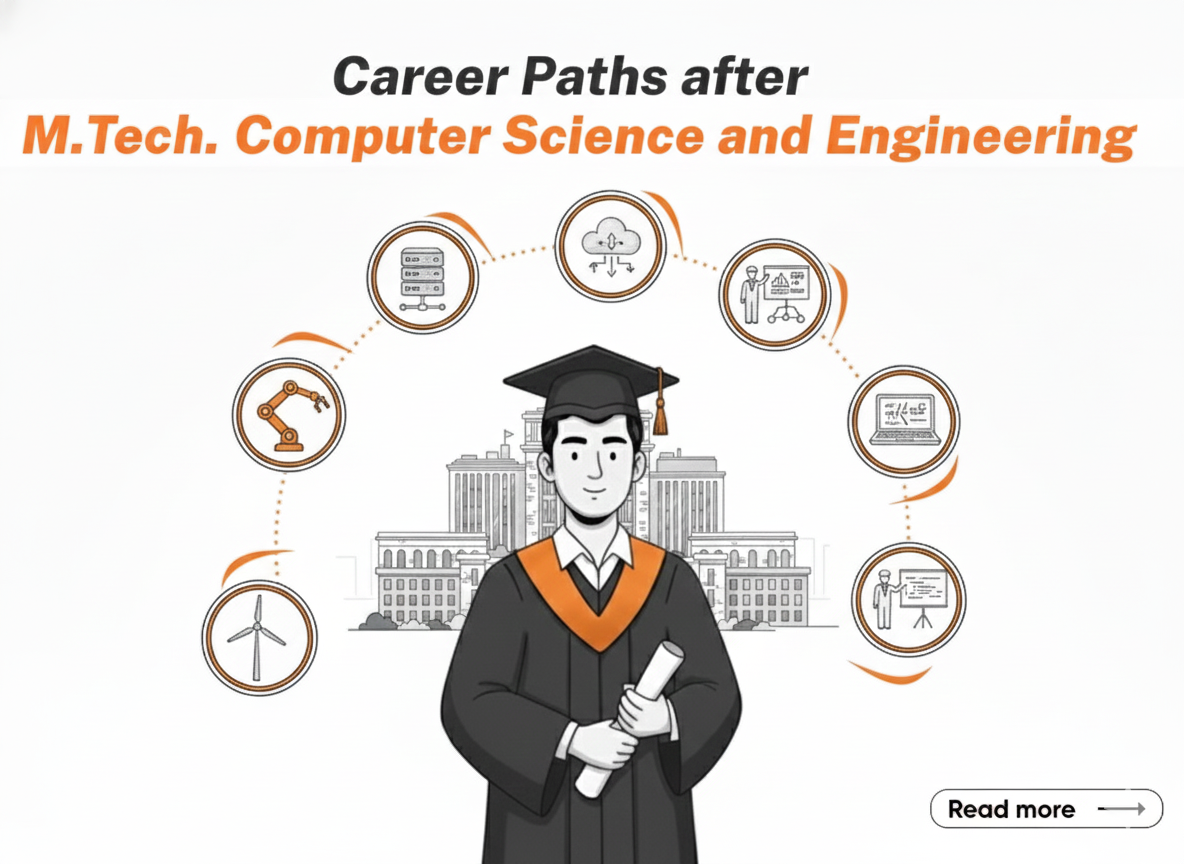
Career Paths after M.Tech. Computer Science and Engineering
An M.Tech. Computer Science and Engineering opens up a wide array of career opportunities across industries, research, and academia.
Graduates acquire advanced technical skills and problem-solving expertise, which make them highly valuable in both specialized and leadership roles.
Career Paths after M.Tech. Computer Science and Engineering are-
| Career Domain | Roles |
| Software Development & Engineering | Software Developer, Full-Stack Developer, Systems Engineer, Mobile App Developer |
| Data Science & Analytics | Data Scientist, Data Analyst, Big Data Engineer, Business Intelligence Analyst |
| Artificial Intelligence & Machine Learning | AI Engineer, Machine Learning Engineer, Deep Learning Specialist, NLP Engineer |
| Cybersecurity & Information Security | Cybersecurity Analyst, Ethical Hacker, Security Consultant, Penetration Tester |
| Cloud Computing & DevOps | Cloud Architect, DevOps Engineer, Site Reliability Engineer (SRE) |
| Research & Academia | Research Scientist, University Lecturer/Professor, R&D Engineer |
| Emerging Technology Domains | Blockchain Developer, IoT Engineer, AR/VR Developer, Quantum Computing Researcher |
| Management & Leadership Roles | Technical Lead, Project Manager, CTO, Product Manager |
An M.Tech. Computer Science and Engineering degree equips graduates with both deep technical expertise and research capabilities, enabling them to pursue high-impact careers in software development, AI/ML, data science, cybersecurity, cloud computing, research, and emerging technologies, while also opening paths to leadership roles in the tech industry.
Top Job Roles for M.Tech. Computer Science and Engineering Graduates
For M.Tech Computer Science & Engineering graduates, there are several promising career paths that leverage their advanced technical skills.
One of the most common roles is that of a Software Engineer, where graduates design, develop, test, and maintain software applications, often progressing to senior developer, tech lead, or architect roles.
Another high-demand role is Data Scientist, which involves analyzing complex datasets to extract insights and drive business decisions, requiring expertise in programming, statistics, machine learning, and data visualization.
With the surge of artificial intelligence, AI or Machine Learning Engineers are also sought after; they build and deploy intelligent models for applications like natural language processing, computer vision, and predictive analytics.
- For those inclined toward academia or cutting-edge research, the role of a Research Associate or Scientist allows graduates to contribute to theoretical and applied research in areas like AI, cybersecurity, and networks, often leading to senior research positions or doctoral studies.
- Other notable opportunities include cloud computing, DevOps, cybersecurity, blockchain development, and full-stack development, making M.Tech. Computer Science and Engineering graduates highly versatile and in demand across industries.
- The most common and sought-after role is that of a Software Engineer or Software Developer, where graduates work on designing, developing, and maintaining software applications, often in backend, full-stack, or product development domains.
- LPU graduates have also been placed as Full-Stack, Backend, or Web/App Developers, taking up roles such as Associate Java/Node.js Developer or Software Trainee in leading IT and product-based companies like Amazon, Microsoft, Cognizant, and Infosys.
- With the rise of AI and data-driven technologies, Data Science, Machine Learning, and AI-related roles are increasingly popular, especially for students who specialized in these areas during their M.Tech.
- LPU M.Tech. Computer Science and Engineering graduates are well-positioned for roles in software development, data and AI, full-stack development, and advanced research, reflecting both versatility and industry demand.
- An M.Tech from LPU equips graduates with the knowledge, practical exposure, and industry connections needed to excel in both core software and emerging technology domains, making them highly versatile and competitive in the job market.
M.Tech. Computer Science and Engineering graduates from LPU have a diverse range of promising career opportunities that align with current industry demands.
The university’s placement trends indicate that roles in software development, full-stack and backend development, data science, AI/ML, and research-oriented engineering are the most accessible and rewarding. While median packages are moderate, strong technical skills, specialization, and hands-on project experience can lead to high-value roles and top-tier packages.
Opportunities in Artificial Intelligence, Machine Learning, and Data Science
Opportunities in Artificial Intelligence (AI), Machine Learning (ML), and Data Science are rapidly expanding, offering a wide range of career paths for skilled professionals.
In AI, graduates can pursue roles such as AI Engineer, Deep Learning Specialist, NLP Engineer, Computer Vision Engineer, or AI Research Scientist, developing intelligent systems, autonomous applications, and advanced algorithms.
Machine Learning offers careers as ML Engineers, ML Researchers, Reinforcement Learning Specialists, or Data Engineers for ML, focusing on building predictive models, optimizing algorithms, and deploying intelligent solutions across industries.
In Data Science, professionals can work as Data Scientists, Data Analysts, Big Data Engineers, Business Intelligence Developers, or Quantitative Analysts, extracting insights from large datasets, building predictive models, and supporting data-driven decision-making in sectors like finance, healthcare, retail, and marketing.
These fields also intersect with advanced computing technologies, creating roles such as Cloud AI Engineer, Robotics Engineer, Edge AI/IoT Developer, and High-Performance Computing Specialist, where professionals implement AI/ML solutions at scale and in real-time systems.
With the global demand for AI, ML, and Data Science experts growing rapidly, these domains offer high-paying and versatile career options in startups, multinational companies, research labs, and emerging technology sectors, making them highly attractive for graduates seeking innovation-driven roles.
Careers in Artificial Intelligence, Machine Learning, and Data Science offer immense growth potential and diverse opportunities across industries.
These fields not only allow professionals to work on cutting-edge technologies like autonomous systems, predictive analytics, and intelligent automation but also provide avenues in research, advanced computing, and cloud-based solutions.
With the increasing reliance on data-driven decision-making and intelligent systems, skilled professionals in AI, ML, and Data Science are in high demand globally, commanding competitive salaries and playing a critical role in shaping the future of technology.
For graduates, pursuing these domains ensures a dynamic, rewarding, and future-ready career path.
Careers in these domains are highly versatile ranging from AI Engineers, ML Engineers, and Deep Learning Specialists to Data Scientists, Data Analysts, and Big Data Engineers allowing professionals to work in diverse sectors such as healthcare, finance, e-commerce, robotics, autonomous vehicles, and cybersecurity.
Research and Development Careers in Computer Science
Research in computer science involves exploring new algorithms, developing novel technologies, and solving complex problems in areas like artificial intelligence, machine learning, cybersecurity, networks, software engineering, and high-performance computing.
R&D professionals analyze theoretical concepts, implement prototypes, and publish findings in scientific journals or conferences. The goal is to push the boundaries of technology, improve existing systems, and create innovative solutions that can be applied across industries.
Key Roles in CS Research:
- Research Scientist / Associate: Conduct advanced research projects, often in AI, ML, cybersecurity, or software systems, contributing to publications and patents.
- Algorithm/Software Researcher: Focus on developing efficient algorithms, optimization techniques, and novel software frameworks.
- AI/ML Researcher: Explore new methods in deep learning, reinforcement learning, natural language processing, and computer vision.
Pursuing a PhD after M.Tech is a natural pathway for students interested in deep research and academia. A PhD allows graduates to specialize in a niche area, contribute original knowledge to the field, and open doors to higher-level R&D positions in both academia and industry.
Many multinational companies, research labs, and governmental organizations highly value PhD holders for leading advanced projects and innovative technologies.
R&D careers in computer science are closely tied to technological innovation. Researchers contribute to breakthroughs in areas such as:
- Artificial Intelligence & Machine Learning: Developing smarter algorithms, neural networks, and AI models.
- Cybersecurity: Designing new protocols, intrusion detection systems, and encryption techniques.
- Quantum Computing & High-Performance Computing: Pushing computational limits for complex simulations and processing large-scale data.
- Human-Computer Interaction & Robotics: Creating intuitive interfaces, autonomous systems, and intelligent machines.
R&D careers provide intellectually rewarding work, the chance to drive technological breakthroughs, and the opportunity to shape the future of computing and its applications across diverse industries.
Government and Public Sector Opportunities
Government and public sector roles are ideal for M.Tech. Computer Science and Engineering graduates seeking stable, high-impact careers that combine technical expertise with national-level projects. These opportunities allow graduates to work on cutting-edge technologies while contributing to critical government and defense initiatives.
Public Sector Undertakings (PSUs) offer stable, well-paying, and prestigious roles for CSE graduates. Many PSUs recruit engineers for IT, software, networking, and systems management roles.
Some top PSUs hiring M.Tech. Computer Science and Engineering graduates include:
Bharat Electronics Limited (BEL), Bharat Heavy Electricals Limited (BHEL), Oil & Natural Gas Corporation (ONGC), Indian Oil Corporation (IOC), etc.
M.Tech graduates can apply for technical positions in central and state government departments. Common roles include: Assistant Engineer / Senior Technical Officer, Systems Engineer / Network Engineer, Software Consultant / Developer, etc.
These roles are often filled through exams like GATE, UPSC, or state-level technical recruitment tests.
Several premier government research organizations hire M.Tech. Computer Science and Engineering graduates for advanced research and development projects: NIC (National Informatics Centre), DRDO (Defence Research and Development Organisation), ISRO (Indian Space Research Organisation) etc.
Strong programming skills, knowledge of AI/ML, cybersecurity, embedded systems, cloud computing, and problem-solving aptitude.
Government and public sector opportunities offer M.Tech. Computer Science and Engineering graduates a stable, prestigious, and impactful career path.
Roles in PSUs, government engineering departments, and premier research organizations like NIC, DRDO, and ISRO allow graduates to work on advanced technologies, e-governance projects, defense systems, and national-level initiatives.
These positions provide not only job security and structured growth but also exposure to cutting-edge research, software development, AI/ML applications, and high-performance computing.
For graduates seeking a career that combines technical expertise with contributions to national development, government and public sector roles present a rewarding and respected pathway.
| Did You Know ?
Many candidates secure positions as Scientists/Engineers in ISRO without going through a conventional interview process, making GATE scores a direct gateway to one of India’s most prestigious space organizations. |
Global Career Options for M.Tech. Computer Science and Engineering Professionals
Global career options for M.Tech. Computer Science and Engineering professionals are vast, spanning software engineering, AI/ML, data science, R&D, cybersecurity, cloud computing, and emerging technologies.
Graduates equipped with advanced technical skills, hands-on project experience, and international exposure can secure high-paying, challenging, and rewarding roles in leading technology companies and research institutions worldwide.
| Category | Roles / Job Titles | Industries / Employers |
| Software Development & Engineering | Software Engineer, Full-Stack Developer, Backend Developer, Systems Engineer, DevOps Engineer | Google, Microsoft, Amazon, IBM, SAP, Infosys, TCS |
| Data Science, AI & Machine Learning | Data Scientist, Data Analyst, AI/ML Engineer, Deep Learning Specialist, NLP Engineer, Computer Vision Engineer | Healthcare, Finance, E-commerce, Autonomous Vehicles, Fintech |
| Research & Development (R&D) | Research Scientist, Software Researcher, AI Researcher, PhD Researcher | Google Research, Microsoft Research, IBM Research, Universities, Innovation Labs |
| Cybersecurity & Cloud Computing | Cybersecurity Analyst, Security Engineer, Cloud Solutions Architect, Blockchain Developer | Tech Corporates, Fintech, Cloud Service Providers |
| Emerging Technologies | Robotics Engineer, Quantum Computing Researcher, IoT/Edge Developer, AR/VR Developer | Robotics Labs, AR/VR Startups, Research Institutes, Smart Technology Firms |
| Global Advantages | N/A | USA, Canada, Germany, Switzerland, Singapore, Australia |
These roles offer high salaries, exposure to cutting-edge projects, and opportunities for international work experience in leading tech companies, research labs, and startups.
By combining advanced technical skills with practical project experience, M.Tech graduates can build rewarding, challenging, and future-ready careers that have a global impact.
Industry Collaborations and Real-World Exposure
Lovely Professional University emphasizes strong industry collaborations and real-world exposure for M.Tech. Computer Science and Engineering students, ensuring they are well-prepared for professional challenges.
The university maintains partnerships with leading IT companies, startups, and multinational corporations such as Microsoft, IBM, Infosys, TCS, and AWS, facilitating guest lectures, workshops, and joint research projects.
Students gain practical experience through internships in top companies and research labs, where they work on live projects involving AI, ML, Data Science, cybersecurity, and cloud computing, often leading to pre-placement offers.
LPU also emphasizes hands-on learning through capstone projects, state-of-the-art laboratory work, and participation in hackathons and coding competitions, allowing students to apply theoretical knowledge to real-world problems.
This combination of industry tie-ups, practical training, and project-based learning enhances technical proficiency, problem-solving skills, and employability, providing M.Tech. Computer Science and Engineering graduates with a strong foundation for successful careers in software development, research, and emerging technology domains.
Internships form a critical part of the M.Tech programme, enabling students to gain hands-on experience in software development, AI/ML model deployment, data analytics, cloud architecture, and cybersecurity solutions.
Many of these internships are conducted in top IT firms, startups, and government research labs, with some students receiving pre-placement offers based on their performance.
LPU also emphasizes capstone and live projects, where students work on practical, industry-relevant problems ranging from AI-driven predictive systems and IoT applications to cybersecurity tools and large-scale software solutions.
Graduates leave the programme with enhanced technical skills, practical experience, professional networks, and strong employability, positioning them for successful careers in software development, AI/ML, data science, cybersecurity, cloud computing, and advanced research roles worldwide.
The university’s state-of-the-art laboratories provide access to advanced computing infrastructure, programming environments, AI/ML frameworks, and cloud platforms.
Students also engage in hackathons, coding competitions, and innovation challenges, sponsored by top tech companies, which nurture creativity, teamwork, and practical application of theoretical knowledge.
Conclusion
In conclusion, pursuing an M.Tech. Computer Science and Engineering offers numerous benefits, including advanced technical knowledge, practical skills, and exposure to emerging technologies such as AI, Machine Learning, Data Science, Cybersecurity, and Cloud Computing.
The programme enhances career growth by preparing graduates for high-demand roles in software development, R&D, government and public sector organizations, and global technology companies.
With opportunities for hands-on projects, internships, and industry collaborations, M.Tech graduates develop problem-solving abilities, innovation skills, and professional networks that boost employability.
Overall, an M.Tech. Computer Science and Engineering equips professionals with the expertise, experience, and versatility needed to excel in a rapidly evolving tech landscape, opening doors to rewarding careers, research opportunities, and leadership roles in both national and international arenas.
From a career perspective, M.Tech. Computer Science and Engineering graduates are well-positioned for high-demand roles such as Software Engineer, AI/ML Engineer, Data Scientist, Research Scientist, Cybersecurity Analyst, Cloud Architect, and Government/PSU positions.
The degree also provides a strong foundation for pursuing PhD programmes or research-based careers, opening doors to innovation, academic positions, and R&D leadership roles in both India and abroad.
Additionally, graduates benefit from global career opportunities, competitive salary packages, and exposure to cutting-edge technologies in multinational companies, startups, and research labs.
The programme enhances critical thinking, problem-solving, project management, and industry-readiness, making graduates versatile professionals capable of contributing to technological advancements and innovation.
Overall, an M.Tech. Computer Science and Engineering equips professionals with the knowledge, skills, and practical experience necessary to excel in the rapidly evolving technology landscape, offering long-term career growth, leadership opportunities, and the ability to make a meaningful impact in both national and international technology sectors.
Beyond technical knowledge, the programme emphasizes hands-on experience through internships, capstone projects, and industry collaborations, enabling students to apply theoretical concepts to real-world challenges and prepare for complex problem-solving scenarios.
Frequently Asked Questions (FAQs)
1. What is M.Tech. Computer Science and Engineering ?
M.Tech (Master of Technology) in Computer Science and Engineering is a postgraduate programme that provides advanced knowledge in computer science domains, including software development, algorithms, AI, ML, Data Science, Cybersecurity, Cloud Computing, IoT, and emerging technologies. It typically spans 2 years and includes theoretical courses, practical labs, research projects, and industry internships.
2. What is the Scope After M.Tech. Computer Science and Engineering ?
M.Tech. Computer Science and Engineering graduates have a wide scope in both industry and research:
Industry Roles: Software Engineer, AI/ML Engineer, Data Scientist, Cybersecurity Analyst, Cloud Architect, Systems Engineer, and DevOps Engineer.
Research & Academia: Opportunities to pursue PhD, join R&D labs, or take faculty positions in universities.
3. What are the Placements After M.Tech. Computer Science and Engineering ?
Top Recruiters: Microsoft, Google, Amazon, IBM, Infosys, TCS, Wipro, Cognizant, Accenture, and startups.
Placement Roles: Software Development, AI/ML, Data Science, Cloud Computing, Cybersecurity, R&D, and System Design.
4. Can I do a PhD after M.Tech. Computer Science and Engineering ?
Yes, M.Tech provides the eligibility and research foundation to pursue a PhD in Computer Science, AI, ML, or Data Science.A PhD opens opportunities in academia as a faculty member, in R&D labs, or in high-level research roles in industry, both in India and globally, allowing you to lead projects, publish papers, and develop cutting-edge technologies.
5. Is M.Tech. Computer Science and Engineering in demand globally?
Yes, M.Tech. Computer Science and Engineering graduates are highly sought after worldwide, especially in AI/ML, Data Science, Cloud, and cybersecurity roles. Countries like the USA, Canada, Germany, Singapore, and Australia offer lucrative opportunities for M.Tech. Computer Science and Engineering professionals, with competitive salaries, challenging projects, and career growth. The global tech industry’s reliance on data-driven solutions and advanced computing ensures strong demand for skilled M.Tech. Computer Science and Engineering graduates.