
Most people would concur that cracking an MBA entrance exam is less about intelligence and more about discipline, consistency, and the right preparation approach. That said, with multiple MBA entrance exams such as CAT, XAT, and LPUNEST, students often find themselves unsure about where to begin and how to prepare effectively. Each MBA entrance exam differs in terms of difficulty, format, and the colleges that accept it. In addition, the selection process may include interviews, group discussions, and profile evaluation, making it essential to approach preparation with complete clarity. The key is not to study more, but to study smart. From choosing the right exam to understanding the syllabus and building a structured preparation plan, every step plays a critical role in your performance.
To help you prepare with the right approach and mindset, in this article, we’ll cover the top MBA entrance exams, their patterns, and a step-by-step preparation strategy.
MBA Entrance Exams 2026: Quick Overview
|
Choose the Right MBA Entrance Exam in 2026
With multiple options available, selecting the right MBA admission entrance exam is a crucial step in your preparation journey. Each entrance test for MBA programmes differs in terms of difficulty, acceptance, and format, so making an informed choice early helps you prepare more effectively.
| Exam | Full Form | Difficulty Level | Frequency | Accepted By |
| CAT | Common Admission Test | High | Once a year | IIMs, FMS, MDI, 1000+ institutes |
| XAT | Xavier Aptitude Test | High | Once a year | XLRI, XIMB, top private B-schools |
| CMAT | Common Management Admission Test | Moderate | Once a year | AICTE-approved colleges, CMAT colleges |
| MAT | Management Aptitude Test | Moderate | Multiple times a year | Wide range of private institutes |
| GMAT | Graduate Management Admission Test | Moderate-High | Year-round | Global universities + select Indian B-schools |
| MAH CET | Maharashtra Common Entrance Test | Moderate | Once a year | MAH CET colleges, Maharashtra institutes |
| LPUNEST | LPU National Entrance & Scholarship Test | Moderate | Multiple slots | Lovely Professional University (MBA Course + Scholarships) |
What Should You Compare Before Choosing an Exam?
Before finalising your MBA entrance exam, evaluate these factors:
- Difficulty Level: CAT and XAT are more competitive, while CMAT, MAT, and LPUNEST are comparatively more accessible.
- Frequency and Flexibility: Exams such as MAT and LPUNEST offer multiple attempts, reducing pressure.
- College Acceptance: Some exams are widely accepted (CAT, CMAT), while others are university-specific.
- Exam Pattern and Sections: Most exams test quantitative aptitude, reasoning, and verbal ability, with slight variations.
- Application Timelines: Keep track of important dates to ensure timely registration and exam preparation.
How to Choose the Right MBA Entrance Exam
Choosing the right exam for MBA admission should be based on a clear strategy:
- Shortlist Your Target Colleges: Check which entrance tests they accept.
- Assess Your Preparation Level: Balance high-difficulty exams with moderate ones.
- Maximise Your Opportunities: Do not rely on a single MBA entrance exam test.
A smart strategy is to prepare for a mix of exams such as CAT + CMAT + LPUNEST. This increases your chances of securing admission and gives you flexibility during the MBA admission process.
LPUNEST: Entrance Exam with Scholarship Advantage
Among the available options, LPUNEST stands out as a student-friendly MBA entrance exam test that offers both admission and scholarship opportunities.
Why Consider LPUNEST:
- Acts as both an entrance examination for MBA and a scholarship test
- Offers flexible exam modes (online remote proctored and test centre-based)
- Provides multiple exam slots, unlike single-attempt exams like CAT
- Quick results, helping you plan your MBA admission faster
- Direct pathway to an industry-oriented MBA Course at LPU
LPUNEST Exam Snapshot
- Duration: 150 minutes
- Format: Multiple-choice questions (MCQs)
- No Negative Marking: Encourages attempts without the fear of penalty
- Balanced Section Distribution: Covers all major aptitude areas evenly
Most MBA entrance exams, including LPUNEST, are designed to assess speed, accuracy, and decision-making under pressure. Since each test has its own unique structure, the next step is to shortlist the ones that align with your goals and track their timelines to plan your preparation effectively.
MBA Entrance Exam Schedule 2026-27
| MBA Entrance Exams | Exam Dates | Registration Window | Result Timeline | Fees |
| CAT 2026 | November 29, 2026* | Aug – Sep 2026* | Dec 2026* | ₹2600* |
| XAT 2027 | January 3, 2027* | Jul – Nov 2026* | Jan 2027* | ₹2200* |
| LPUNEST 2026 | April – May 2026 (multiple slots) | Mar – Apr 2026 | Within 24 working hours | Varies by phase |
| CMAT 2027 | Jan end / Feb 2027* | Nov – Dec 2026* | Feb 2027* | ₹2500* |
| MAH CET 2026 | April 6-8, May 9, 2026 | Jan – Feb 2026 | May 2026 | ₹1000 |
| MAT 2026 | May 17 (PBT), May 24 (CBT) | Mar – May 2026 | June 2026 | ₹1800 |
| GMAT 2026 | Year-round | Year-round | Instant / Few days | ~$275 |
*Expected
Understand MBA Entrance Exam Pattern and Syllabus
Every entrance examination for MBA evaluates a common set of core skills, even though the format and weightage may vary slightly across exams. Instead of treating the syllabus as static, it is more useful to understand what each section tests and how you should prepare for it.
A strong performance in any MBA entrance exam test depends on balancing concept clarity, practice, and speed across all sections. Here’s a section-wise breakdown and preparation strategy.
-
Quantitative Aptitude
This section tests your numerical ability, including arithmetic, algebra, and number systems, with a focus on problem-solving under time pressure.
How to Prepare:
- Start with basics such as percentages, ratios, and averages before moving to advanced topics
- Focus on understanding concepts rather than memorising shortcuts
- Practise a variety of questions to improve speed and accuracy
- Maintain a formula sheet for quick revision
Consistent practice is key. This section rewards clarity and repetition.
-
Logical Reasoning
This section evaluates your ability to identify patterns, analyse relationships, and solve problems using structured logic.
How to Prepare:
- Practise different types of reasoning sets such as arrangements, puzzles, and logical sequences
- Focus on understanding the structure of each set before attempting to solve it
- Improve accuracy first, then work on speed
- Solve full sets to build exam-level problem-solving ability
Logical Reasoning is highly practice-driven, and exposure to different question types plays a key role in improving performance.
-
Data Interpretation (DI)
This section tests your ability to interpret and analyse data presented in charts, tables, graphs, and caselets.
How to Prepare:
- Practise interpreting data from bar graphs, pie charts, tables, and mixed data sets
- Focus on calculation accuracy and shortcut techniques where applicable
- Improve data selection and question prioritisation
- Work on solving complete sets under time constraints
Data Interpretation requires a balance of calculation speed, accuracy, and decision-making under pressure.
-
Verbal Ability
This section evaluates reading comprehension, grammar, vocabulary, and overall language skills.
How to Prepare:
- Develop a daily reading habit (editorials, articles, business news)
- Focus on understanding passages rather than just answering questions
- Improve vocabulary gradually through context-based learning
- Practise sentence correction and para-jumbles regularly
Strong reading skills can significantly boost your overall MBA entrance exam score.
-
General Awareness (for exams like CMAT)
This section tests your awareness of current events, business trends, and general knowledge relevant to management studies.
How to Prepare:
- Follow current affairs regularly (especially business and economy)
- Read monthly GK summaries or revision notes
- Focus on key events rather than memorising excessive facts
Consistency matters more than last-minute preparation in this section.
Build a Structured Preparation Strategy
A well-planned approach can make a significant difference in your performance in any admission test for MBA. Instead of studying randomly, you need a system that balances concept-building, practice, and revision. The goal is not just to complete the syllabus, but to improve accuracy, speed, and decision-making over time.
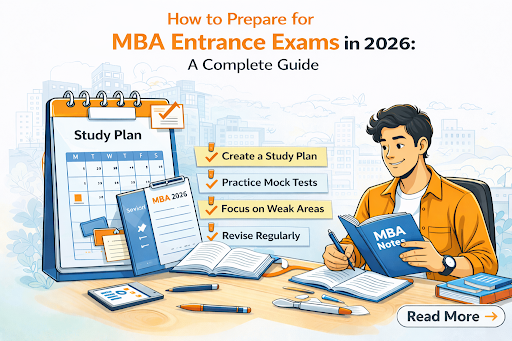
- Create a Study Plan: Start with a realistic plan that fits your daily schedule. Break your preparation into weekly targets covering all sections, and allocate extra time to areas that need improvement. Consistency matters more than long, irregular study sessions.
- Identify Strengths and Weaknesses: Take an initial mock test to understand where you stand. Focus on improving weak areas without neglecting your strong sections, as both contribute to your overall score in an MBA entrance exam.
- Build Conceptual Clarity: Avoid jumping straight to shortcuts. Strong fundamentals in topics like arithmetic, reasoning patterns, and reading comprehension will help you solve unfamiliar questions during the exam.
- Identify and Choose the Best Books and Resources: Choosing the right study material can make your preparation more efficient. Instead of using too many sources, focus on a few reliable ones and practise consistently. Combine books with online mock platforms to build both conceptual clarity and test-taking skills.
- Practice with Mock Tests: Mock tests are essential for any MBA entrance exam test. They help you simulate real exam conditions, improve time management, and identify recurring mistakes. Analyse every mock test in detail, not just your score.
- Revise Consistently: Revision is what converts learning into performance. Maintain short notes or formula sheets for quick revision, especially for Quantitative Aptitude and key concepts.
- Improve Time Management: Learn how to balance speed and accuracy. Practise sectional timing and develop a strategy for deciding which questions to attempt and which to skip.
| Did You Know? Over 2.95 lakh students applied for CAT 2025, and around 2.58 lakh appeared for the exam, but only about 8,000 candidates secured seats in the IIMs.While the numbers may seem competitive, an MBA is not limited to a single exam or a handful of colleges. Many top universities offer multiple admission pathways through exams such as CMAT, MAT, and LPUNEST, giving you more opportunities to secure admission and scholarships.With the right strategy, consistent preparation, and smart exam selection, you can significantly improve your chances of getting into a strong MBA programme.Source: https://bschool.careers360.com/articles/how-many-students-get-selected-in-iim |
A 6–9 Month MBA Entrance Exam Preparation Plan
A structured timeline helps you stay focused and ensures you cover all areas without last-minute pressure. Whether you are preparing for CAT, CMAT, or LPUNEST, a phased approach works best. Suggested Plan
- Month 1-3: Concept Building
Focus on understanding fundamentals across all sections. Build a strong base in Quant, reasoning, and verbal skills. Avoid rushing through topics and prioritise clarity over speed.
- Month 4-6: Practice and Application
Start taking sectional and full-length mock tests. Focus on improving accuracy, identifying weak areas, and strengthening your problem-solving approach. Begin timing your attempts to build exam readiness.
- Month 7-9: Revision and Test Strategy
Shift your focus to revision and full-length mock tests. Work on test-taking strategy, question selection, and time allocation. Fine-tune your approach to maximise performance in the actual MBA entrance exam.
MBA Entrance Exam Scores & Percentiles: What You Need to Aim For
Understanding how MBA entrance exam scores translate into percentiles and college cut-offs is essential for setting realistic goals. Most top institutes shortlist candidates based on percentiles rather than raw scores, which means your performance is evaluated relative to other test-takers.
Here’s a general idea of what different percentile ranges can get you:
- 99+ percentile: Top IIMs (Ahmedabad, Bangalore, Calcutta), FMS Delhi, and other premier institutes
- 95–99 percentile: Newer IIMs and leading private B-schools such as MDI, SPJIMR, and IMT
- 85–95 percentile: Well-established private universities and reputed management institutes
- 70–85 percentile: Universities with strong academic frameworks and industry exposure
At the same time, MBA admissions are not limited to percentile-based pathways alone. Many universities offer their own entrance exams, such as CMAT, MAT, and LPUNEST, which provide additional opportunities for admission along with benefits such as flexible exam attempts and scholarships.
It is important to note that cut-offs vary each year based on exam difficulty and competition. In addition, several institutes evaluate candidates based on interviews, academic background, and overall profile alongside entrance exam scores.
Instead of focusing only on achieving a specific percentile, a more effective approach is to maximise your opportunities by preparing for multiple exams and keeping diverse admission pathways open.
Common Mistakes to Avoid
Avoiding common mistakes can significantly improve your performance in any MBA admission entrance exam.
- Ignoring Mock Test Analysis: Simply taking tests is not enough. Analyse your mistakes to avoid repeating them.
- Over-Focusing on One Section: A high score in one section cannot compensate for poor performance in another.
- Lack of Revision: Without regular revision, concepts fade quickly, especially in Quant.
- Poor Time Management: Spending too much time on difficult questions can reduce your overall score.
- Starting Too Late: Rushed preparation often leads to gaps in concepts and low confidence.
- Ignoring Health and Routine: Poor sleep, irregular study hours, and lack of physical activity can reduce focus and productivity. A consistent routine improves retention and performance.
- Burnout from Over-Studying: Studying for long hours without breaks can lead to fatigue and reduced efficiency. Short breaks and balanced study sessions help maintain focus.
MBA Entrance Exam Day Strategy
Your performance on the exam day is not just a reflection of your preparation—it depends heavily on how well you execute your strategy under pressure. Even well-prepared candidates lose marks due to poor time management, panic, or wrong question selection.
A clear plan for your MBA entrance exam can help you stay in control and maximise your score.
-
Start with a Smart Question Selection Strategy
Do not attempt questions randomly. Begin with questions that look familiar and manageable to build momentum and confidence.
- Scan the section quickly before starting
- Pick easy-to-moderate questions first
- Skip lengthy or confusing questions initially
The goal is to secure marks early, not to solve everything.
-
Manage Time Across Sections, Not Just Questions
Time management is not only about speed; it is about allocation.
- Set a rough time limit for each section before the exam
- Avoid spending too long on a single question
- Keep track of time without checking the clock too often
Remember, leaving a few difficult questions is better than missing easy ones later.
-
Balance Accuracy with Attempts
Many students focus only on the number of attempts, but accuracy is equally important, especially in exams with negative marking.
- Attempt questions you are reasonably confident about
- Avoid blind guessing
- Use elimination techniques where possible
A balanced attempt strategy often scores higher than aggressive guessing.
-
Handle Difficult Sections Calmly
It is common for one section to feel tougher than expected.
- Do not panic if you find a section difficult
- Move ahead and return later if time permits
- Focus on maximising your score in easier sections
The paper is usually balanced; if it is tough for you, it is tough for others too.
-
Stay Mentally Composed Throughout the Exam
Your mindset can directly impact your performance.
- Avoid comparing your progress with others (in test centres)
- Take a few seconds to reset if you feel stuck
- Maintain steady focus rather than rushing
A calm and composed approach helps you make better decisions under pressure.
-
Plan Your Final 10-15 Minutes
The last few minutes of the MBA entrance exam are crucial.
- Revisit marked questions if time allows
- Avoid rushing into new difficult questions
- Double-check answers where possible
This phase can help you pick up extra marks without taking unnecessary risks.
The MBA entrance exam is not about attempting every question; it is about making the right decisions at the right time. A well-executed strategy can often make the difference between an average score and a high percentile.
Plan Your MBA Applications Alongside Exam Preparation
Do not wait until after your MBA entrance exam test results to start applying.
What You Should Do:
- Apply to multiple colleges
- Track application deadlines
- Keep documents ready (SOP, resume, transcripts)
- Shortlist backup options
This ensures you do not miss opportunities due to tight timelines.
Choose the Right MBA Programme and Institution
After completing your entrance examination for MBA, the next critical step is selecting the right college and programme. Your MBA experience, and future career outcomes, depend significantly on this decision. Instead of choosing based only on brand name or exam score, you should evaluate colleges on a combination of academic, financial, and career factors.
If you are looking for a programme that combines academic rigour with industry exposure, Lovely Professional University offers a well-rounded MBA experience.
What Sets LPU Apart
- Recognised Ranking: Ranked 44th in NIRF 2025 (Management category), reflecting strong academic standards and outcomes
- Wide Range of Specialisations: Offers diverse MBA programmes, including industry-relevant domains such as fintech, analytics, and healthcare management
- Industry Certifications: Integrated certifications from organisations such as KPMG, IBM, and SHRM, helping you build practical, job-ready skills
- Experiential Learning Approach: Business simulations, live projects, and hands-on learning ensure you apply concepts in real-world scenarios
- Strong Placement Ecosystem: Consistent recruiter participation and structured placement support drive strong outcomes: ₹49.4 LPA highest package, ₹13.6 LPA average (top 10%), and 450+ recruiters.
Take the Next Step Towards Your MBA with LPUNEST
If you are planning to appear for an MBA entrance exam in 2026 or 2027, it is no better time to take action than today. Start by choosing the right exam, building a preparation strategy, and exploring universities that align with your goals.
Lovely Professional University offers a flexible admission pathway through LPUNEST, which serves as both an entrance examination for MBA and a scholarship test. With multiple exam slots and a student-friendly format, LPUNEST provides a practical option for candidates aiming to secure admission in a reputed MBA programme. Explore the MBA Course options at LPU and check the LPUNEST schedule and application process to begin your journey.
Frequently Asked Questions
Q.1 Which MBA entrance exam should I take in 2026?
Choose based on your target colleges and preparation level. CAT suits top institutes, while CMAT, MAT, and LPUNEST offer wider and more flexible opportunities. A mix of exams increases your chances.
Q.2 How much time is required to prepare for MBA entrance exams?
Most students need 6-9 months of focused preparation. The timeline depends on your conceptual clarity and consistency. Quality of practice matters more than duration.
Q.3 Can I crack MBA entrance exams without coaching?
Yes, with a structured plan, reliable resources, and regular mock tests, self-study can be effective. Coaching helps with guidance, but it is not essential for success.
Q.4 How many mock tests should I take?
Aim for 15-25 full-length mocks with proper analysis. Reviewing mistakes is more important than the number of tests. This helps improve both accuracy and strategy.
Q.5 What are the most important subjects for MBA entrance exams?
Quantitative Aptitude, Logical Reasoning, Data Interpretation, and Verbal Ability are core areas. Some exams also include General Awareness. All sections require both accuracy and speed.
Q.6 Is CAT compulsory for MBA admission?
No, CAT is required mainly for IIMs and select institutes. Many colleges accept CMAT, MAT, GMAT, and LPUNEST. Always check exam acceptance before applying.
Q.7 Is LPUNEST mandatory for MBA at LPU?
No, LPU also accepts CAT, XAT, MAT, and CMAT scores. However, LPUNEST offers a direct admission route along with scholarship opportunities.
Q. 8 How can I improve speed and accuracy?
Build strong concepts first, then practise timed questions. Regular mock tests and analysis help identify mistakes and improve performance over time.
Q.9 What is a good score in MBA entrance exams?
A good score depends on the exam and target colleges. Higher percentiles are needed for top institutes, while other colleges have flexible cut-offs. Focus on your target college requirements.