- What is the scope of BCA Virtual Reality with Artificial Intelligence in today’s Industry?
- Why BCA Virtual Reality with Artificial Intelligence is a Smart Career Choice Today?
- Key Domains and Subjects Covered in BCA Virtual Reality with Artificial Intelligence
- Essential Skills to Succeed in BCA Virtual Reality with Artificial Intelligence
- Career Options After BCA in Virtual Reality with Artificial Intelligence
- Scope and Salary Trends for BCA Virtual Reality with Artificial Intelligence
- Top Recruiters Hiring BCA Virtual Reality with Artificial Intelligence
- What After Graduation? Higher Studies & Certifications for BCA Virtual Reality with Artificial Intelligence Students
- Final Thoughts
- Frequently Asked Questions (FAQs)
What is the scope of BCA Virtual Reality with Artificial Intelligence in Today’s Industry?
BCA Virtual Reality with Artificial Intelligence is a three-year full-time undergraduate degree that blends immersive technology with intelligent systems to prepare students for cutting-edge roles in tech, gaming, healthcare, and beyond.
It is a forward-thinking undergraduate programme designed to equip students with expertise in two of the most transformative technologies of the 21st century. The curriculum is industry-aligned and hands-on, covering tools like Unity, Unreal Engine, TensorFlow, and Python to help students build real-world applications in fields such as gaming, healthcare, education, and smart environments.
With access to modern labs, strong industry tie-ups, and an emphasis on project-based learning, LPU ensures students gain both theoretical knowledge and practical skills.
A BCA Virtual Reality with Artificial Intelligence is a future-proof, high-potential degree, especially if you pair it with practical skills, projects, internships, and further learning.
It is a valuable degree today because skills in immersive tech + AI are increasingly in demand in gaming, simulation, training, design, etc. Since the field is quite new, having a specialization in Virtual Reality and Artificial Intelligence could give you a niche skill set.
At Lovely Professional University, the course tends to have good infrastructure, labs, industry tie-ups, and a focus on co‑curricular work (projects, internships). This can help in applied learning.
Furthermore, given India’s push in digital transformation, 5G rollout, more affordable hardware, increasing internet penetration and growing interest in metaverse / XR experiences, the time is ripe.
| Did You Know? Estimates by NITI Aayog (India’s policy think tank) suggest that faster adoption of AI could add US$500‑600 billion to India’s GDP by 2035. |
Why BCA Virtual Reality with Artificial Intelligence Is a Smart Career Choice Today?
A specialization that combines Virtual Reality and Artificial Intelligence positions you exactly where market demand is rising steeply. Skills like 3D modeling, immersive design, simulation, computer vision, and AI‐powered interactivity are less common but increasingly required.
Employers look for candidates who can not just code, but also build immersive experiences, understand hardware & software of VR/AR, etc. (E.g. as per a survey of AR/VR job postings, UI/UX, software design, graphics rendering are highly in demand).
In the rapidly evolving tech ecosystem of India, choosing a specialization like BCA Virtual Reality with Artificial Intelligence at Lovely Professional University represents not just a degree but a strategic alignment with where the future is heading.
The market is ready for people who don’t just understand programming or machine learning theory, but those who can build immersive, interactive environments, VR simulations, AI‐driven virtual assistants, computer vision applications, and XR user experiences, which are increasingly in demand across multiple sectors.
At LPU, the infrastructure, labs, industry tie-ups, and project-based learning amplify your ability to convert that market potential into concrete skills. You won’t just learn theory, you will (ideally) get hands‑on experience with VR hardware (headsets, motion tracking, etc.), design and build simulations, use AI/ML tools, do 3D modeling, user interaction design, etc. With these skills, your profile will be more compelling compared to someone with a more traditional BCA, because you bring specialized, emerging‐tech capabilities.
| Did You Know? India’s Virtual Reality market is growing rapidly, projected to rise from $1.2 billion in 2024 to $3.44 billion by 2030 at a CAGR of ~19%, driven by adoption in gaming, education, real estate, and immersive training. |
Key Domains and Subjects Covered in BCA Virtual Reality with Artificial Intelligence.
In BCA specializing in Virtual Reality (VR) & Artificial Intelligence (AI), students dive into foundational computer science topics like programming with languages such as Python, C++, or Java; data structures and algorithms; database systems; operating systems; computer networking; and discrete mathematics.
On the AI side, the curriculum typically covers machine learning (supervised, unsupervised), deep learning, computer vision (image/video processing, gesture recognition), natural language processing, and possibly reinforcement learning.
There are also subjects exploring Human‑Computer Interaction, ethics of AI/VR, usability, and interaction design to ensure students understand user comfort, safety, and social/legal implications.
There is a strong blend of VR‑focused work, including 3D graphics, modeling and animation, environment design, virtual interaction design (UX/UI for immersive environments), and hands‑on experience with VR tools and engines like Unity or Unreal Engine; students also work with hardware/sensors where available.
Finally, this specialization usually includes project or lab work each semester, mini‑projects or capstones, electives for deeper specialization (for example, in computer graphics, AI applications, virtual simulation), and possibly a field or industrial project to tie learning to real‑world problems.
Generic Electives which are offered in LPU are-
- ACCOUNTING
- GENERAL MANAGEMENT
- INTERNET OF THINGS
- LAW AND TAXATION
- SALES AND MARKETING
| Did You Know? A report by India’s Ministry of Electronics & IT projects that the demand for AI professionals in India will reach ~1 million by 2026 |
Essential Skills to Succeed in BCA Virtual Reality with Artificial Intelligence
To thrive in a BCA specializing in Virtual Reality (VR) & Artificial Intelligence (AI), a student needs a balanced mix of technical, creative, and soft skills. On the technical side, proficiency in programming languages like C#, C++, and Python is vital for scripting behaviour in Unity or Unreal Engine, handling AI/ML models, or processing sensor data.
Understanding and using VR/AR SDKs and APIs (such as Vuforia, ARCore, ARKit, Oculus SDK) is very useful to build interactive immersive applications. Skills in 3D modeling and animation using tools like Blender, Maya or similar software help in designing virtual environments, assets, textures and animations that feel real.
Geometry, spatial mathematics, and linear algebra, and geometry are also important. VR requires handling coordinate transformations, rendering 3D scenes, tracking and alignment. On the AI side, you will want familiarity with machine learning basics (supervised/unsupervised learning), computer vision (image/video processing, gesture tracking), and possibly natural language processing if virtual assistants or conversational agents are involved.
LPU also offers short‑term courses like Augmented Reality-based mobile app development using Unity & Vuforia that give hands‑on exposure in AR/VR SDKs, 3D environment setup and app deployment.
Problem‑solving and creativity go hand in hand: you will often invent new interaction paradigms or figure out how to optimize performance (frame rates, latency), especially on constrained hardware.
Good communication skills, ability to work in teams, adapt to new tools, and continuous learning are essential: tech changes fast, so keeping up with new VR hardware, AI frameworks, design principles, etc., is a must.
BCA Virtual Reality with Artificial Intelligence at Lovely Professional University offers more than just a degree; it is a pathway into the future. As India moves rapidly toward immersive technologies, AI‑powered systems, and experiential learning, this course positions students at the nexus of what’s most in demand. From mastering fundamentals like programming, data structures, and AI/ML to hands‑on skills in VR design, 3D modeling, UX for immersive environments, and real hardware tools, students gain both breadth and depth.
Career Options After BCA Virtual Reality with Artificial Intelligence
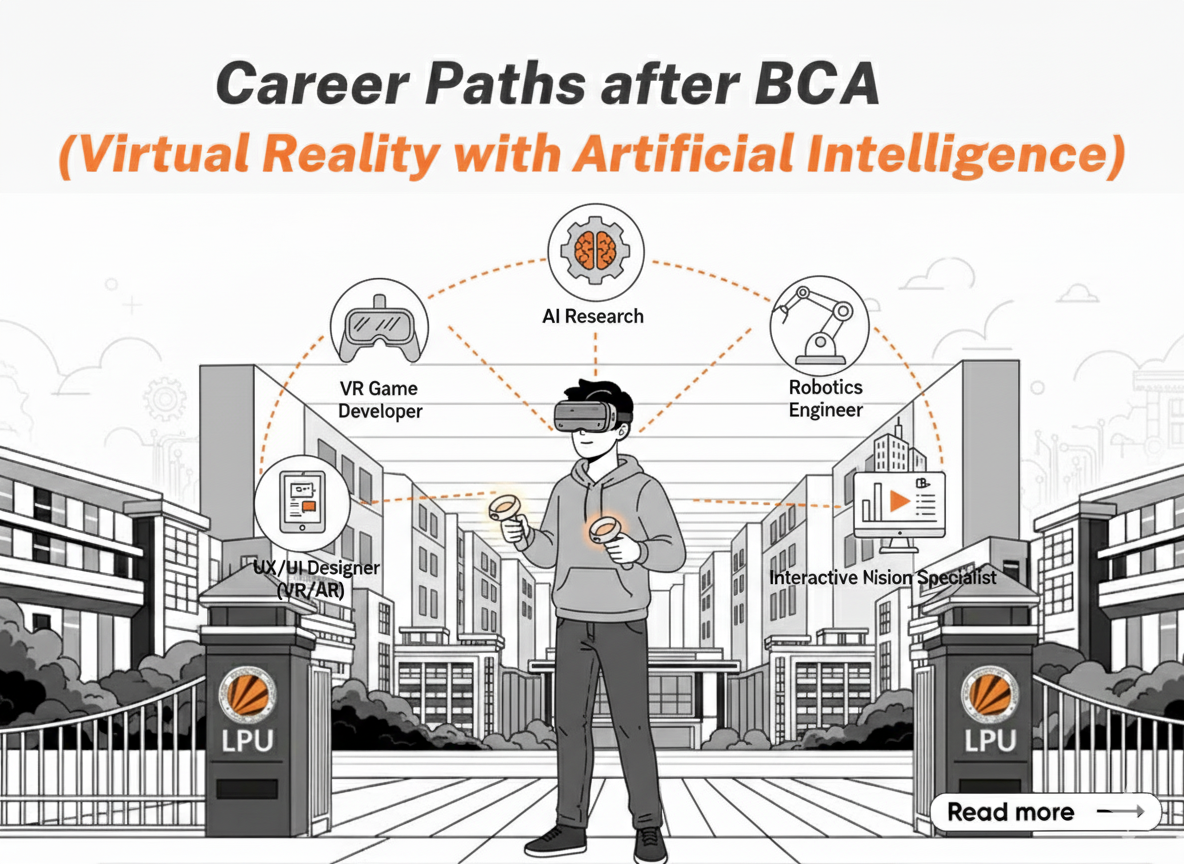
After completing a BCA Virtual Reality with Artificial Intelligence, graduates in India can pursue roles such as VR/AR Developer, AI Engineer, XR (Extended Reality) Content Designer, Simulation/Training Module Creator, UX/UI Designer for Immersive Environments, or even Consulting roles that blend immersive tech and AI.
Entry‑level VR/AR developer salaries (fresher or 0‑2 years of experience) typically range from around ₹2–6.5 lakhs/year, depending on city and company.
Career Roles You Can Aim For-
-
- AR/VR Developer / Unity / Unreal Engineer-
You’ll build immersive applications: virtual environments, simulations, training modules, entertainment, etc. Jobs often require skills like Unity or Unreal Engine, C# / C++, 3D modeling, texture/graphics work, optimizing for performance.
- AR/VR Developer / Unity / Unreal Engineer-
- AI Engineer (Computer Vision / Deep Learning / ML Ops)-
-
-
- Since VR often needs computer vision (for gesture tracking, spatial mapping, recognition), roles in image/video processing, model deployment, and proper pipeline building are relevant.
-
- XR / Extended Reality Support & Maintenance Engineer-
-
-
- Companies that use VR / AR (in training, education, simulation, and entertainment) need engineers who can support hardware/software, troubleshoot, ensure optimal user experience, and maintain VR systems.
-
- Content Creator / Digital Reality Content Designer-
-
-
- For those inclined toward creative work: designing immersive narratives, virtual tours, educational content, interactive storytelling, and marketing through VR/AR experiences. Skills like 3D modeling, animation, video editing, and UX in VR are needed.
-
- Instructional Designer / Training Simulations Developer-
-
-
- Many sectors—healthcare, industrial training, defence, corporate training—use VR/AI to simulate real situations for safe training. Designing curricula, building VR modules, and integrating AI feedback/analytics fall under this.
-
- AI + AR/VR Research / R&D Roles-
-
- For those interested in pushing the boundaries: research scientist roles (academic or in industry), working on improving algorithms, VR hardware, user experience, interaction modalities, and AI‑driven immersive tech.
| Did You Know? India is undergoing a tech transformation, with VR and AI rapidly becoming mainstream. AI job postings have risen by 42% in two years, driven by demand in healthcare, manufacturing, retail, and consumer electronics. |
Scope and Salary Trends for BCA Virtual Reality with Artificial Intelligence Graduates
The fact that LPU already offers a specialized BCA Virtual Reality with Artificial Intelligence means there is institutional support (curriculum, labs/infrastructure, etc.). Also, companies have shown interest by offering high packages in AI/ML, which is a good sign that related fields like AI + VR have potential.
To access the higher salaries, you would likely need to do more than just the degree: build VR/AI projects, possibly do internships, get good coding + 3D graphics/game engine skills, maybe some certifications, etc.
As you gain experience (say 2‑3 years), salaries improve significantly.
Also, being in a tech hub helps, and choosing companies doing cutting-edge work in AI & VR helps you command a premium.
The estimated salary ranges from ₹3,00,000 to ₹6,00,000 per annum for roles in basic VR/AR development or junior AI/ML roles.
Salaries also range from ₹25,00,000 to ₹40,00,000+ and higher for higher-level profiles.
Because more students will be interested once these specialized fields become popular, just having the degree may not be enough. One must stay current with tools (Unity, Unreal, AI/ML frameworks, etc.), and also possibly use the resources that LPU provides (labs, workshops, projects) well.
LPU runs a programme called Professional Enhancement Programme (PEP) or Placement / Enhancement / Professional trainings. These include soft skills, domain-specific labs, workshops, etc.
Recruitment companies are strong: several reputed IT/AI/VR/software companies hire from LPU.
Top Recruiters Hiring BCA Virtual Reality with Artificial Intelligence Graduates
From recent placement reports at LPU, the companies that frequently visit campus and hire students across tech‑disciplines (including VR/AI‑adjacent roles) include:
- Google, Microsoft, Amazon — these global giants often have AI, ML, cloud, AR/VR, and cutting‑edge product teams.
- Infosys, TCS, Cognizant, Accenture, Capgemini — major Indian/Global IT services firms. They hire many graduates, including those with foundations in VR/AI (though roles may begin more generic).
- Cisco, Autodesk, Intel — companies with strong hardware, graphics, or design/visualization wings; these can offer roles more closely aligned with VR/AR/graphics, and sometimes integration of AI.
- Bosch, HCL, IBM — tend to recruit for R&D, embedded systems, simulation, IoT, etc., which can intersect with VR/AI in areas like computer vision, real time systems.
If you graduate with a BCA Virtual Reality and Artificial Intelligence background, these big companies (Microsoft, Google, Amazon, Cognizant, etc.) may recruit you, especially if you show relevant projects, internships, skills (Unity/Unreal, 3D modelling, computer vision, ML, etc.). Sometimes you may begin in a general “developer/analyst/software engineer” role and then shift into specialised VR/AI work.
Specialized firms like SpectoV or startups in the immersive tech space might offer more focused roles earlier on (for example, VR content creation, interactive simulations, AR/VR app dev), but they might also require more proof of skill (portfolio, hands‑on experience).
The presence of companies like Autodesk, Cisco, Intel, etc., is beneficial: even if they don’t always have “VR/AI developer” roles, they may have graphics, simulation, hardware, IoT, or related divisions which value overlapping skills.
Lovely Professional University (LPU) offers a strong foundation for students pursuing a BCA Virtual Reality with Artificial Intelligence, combining cutting-edge technologies with practical exposure. The university’s focus on industry-aligned curricula, hands-on labs, and a professional enhancement programme equips students with both theoretical knowledge and real-world skills. LPU’s consistent placement record with top recruiters like Microsoft, Google, Amazon, TCS, Cognizant, and Accenture demonstrates its credibility in producing industry-ready graduates.
What After Graduation? Higher Studies & Certifications for BCA Virtual Reality with Artificial Intelligence Students
After completing a BCA Virtual Reality with Artificial Intelligence, especially from a university like LPU, you will have multiple pathways to grow your career. You can either enter the job market or go for higher studies and certifications to specialize further and boost your prospects.
One of the most common academic paths is pursuing an MCA (Master of Computer Applications) with a specialization in AI, data science, or immersive technologies. Alternatively, students can opt for a Master’s degree (M.Sc. or M.Tech) in fields like Artificial Intelligence, Machine Learning, Game Development, Human-Computer Interaction, or Virtual Reality, which are available at top institutions in India and abroad.
For students seeking global exposure, pursuing an MS abroad in countries like the USA, Canada, or Germany in AI/VR-related domains is another viable route.
- In addition to higher education, obtaining professional certifications in AI (e.g., Google TensorFlow, IBM AI Engineering), VR/AR (e.g., Unity or Unreal Engine), and cloud technologies (AWS, Azure) significantly boosts employability.
- Short-term certifications can help you build practical skills, stand out to employers, or even switch specializations within tech. Top areas for BCA Virtual Reality with Artificial Intelligence grads.
- AI & Machine Learning Certifications
Google AI / TensorFlow Developer Certificate
IBM AI Engineering Professional Certificate
Microsoft Certified: Azure AI Engineer Associate
Deep Learning Specialization by Andrew Ng
Final Thoughts
Pursuing a BCA Virtual Reality with Artificial Intelligence is a forward-thinking and future-ready choice, especially as immersive technologies and AI are rapidly reshaping industries worldwide. This interdisciplinary programme equips students with foundational computer science skills while also preparing them for the evolving landscapes of VR/AR, artificial intelligence, machine learning, computer vision, and 3D interaction.
As industries increasingly adopt AI for automation, data insights, and VR/AR for training, simulation, design, healthcare, education, and entertainment, the demand for professionals skilled in both areas is expected to grow significantly. Graduates from well-established institutions like LPU gain the advantage of structured academic support, access to tech-driven labs, internships, and strong placement networks with top recruiters.
Looking ahead, the future in VR and AI is highly promising, with career opportunities ranging from VR/AR developer, AI/ML engineer, XR designer, to roles in metaverse development, game tech, robotics, and smart environments. Continued learning through higher studies or specialized certifications, along with a strong personal portfolio, will play a key role in unlocking high-paying and impactful career paths.
A BCA Virtual Reality with Artificial Intelligence offers a strong and future-oriented foundation for students aiming to build careers in two of the most transformative technologies of our time. With the growing integration of AI and VR across industries from gaming and education to healthcare and smart cities, the demand for skilled professionals is only expected to rise. Institutions like LPU provide not just academic training but also placement support and exposure to industry trends, giving graduates a competitive edge.
Frequently Asked Questions (FAQs)
- Is BCA Virtual Reality with Artificial Intelligence a good course for the future?
Yes, this course is highly relevant to the future of tech. Both VR/AR and AI are rapidly growing fields with applications in healthcare, gaming, education, manufacturing, real estate, and more. Professionals with skills in both areas are in high demand.
- What is the average salary after BCA Virtual Reality with Artificial Intelligence?
The average starting salary ranges from ₹4–8 LPA, depending on your skills, projects, and internships. With experience, salaries can grow to ₹12–20+ LPA, and in some cases (with strong specialization), even higher packages are possible.
- Does LPU offer good placements for this course?
Yes, LPU has a solid placement record. Companies like Microsoft, Amazon, Capgemini, and Cognizant hire from LPU. Students who actively build portfolios, complete internships, and earn certifications typically receive better offers.
- Can I start my own startup after this course?
Absolutely. With skills in VR and AI, you can build innovative solutions in gaming, training, education, virtual tours, or smart applications. LPU also offers entrepreneurship support through its incubation programmes.
- Is this course suitable for students from non-science backgrounds?
Yes, most BCA programmes, including LPU’s, are open to students from any stream (Science, Commerce, Arts) who have studied Mathematics or Computer Applications at the 10+2 level. However, interest in coding and tech is important.