- Why Choosing the Right Diploma Course Matters?
- What Is a Diploma in Computer Science and Engineering?
- Who Should Consider a Diploma in Computer Science and Engineering?
- Core Skills You’ll Develop During the Diploma Programme
- Benefits of Pursuing a Diploma in Computer Science and Engineering
- Industries That Actively Hire Diploma in CSE Professionals
- Advantages of Starting a Career Early with a Diploma Qualification
- Personality Traits and Interests That Match Diploma in CSE
- Alumni Success Stories
- Future Growth and Career Possibilities in Computer Science
- Conclusion
- Frequently Asked Questions (FAQ)
Why Choosing the Right Diploma Course Matters?
Choosing a diploma after 10th is a smart choice for students who want early skills, quick employment options, and a practical approach to learning. From engineering to creative arts, there’s a diploma course for every interest.
There are many excellent diploma options available, such as engineering diplomas in mechanical, civil, electrical, and computer science; IT and computer courses like web designing, graphic designing, and computer applications; paramedical programmes including DMLT, X-ray technology, and nursing assistant; as well as courses in hotel management, travel & tourism, digital marketing, business administration, fashion designing, animation, photography, and various vocational trades like electrician, fitter, and plumbing.
Best Diploma Courses After 10th- Engineering & Technical Diplomas
- Ideal for students who enjoy science, machines, or technology-
- Diploma in Mechanical Engineering,
- Diploma in Civil Engineering,
- Diploma in Electrical Engineering,
- Diploma in Computer Science,
- Diploma in Electronics & Communication,
- Diploma in Automobile Engineering.
Choosing a diploma matters because it provides a skill-focused, practical education that prepares students for employment faster than traditional academic pathways.
Diplomas are cost-effective, shorter in duration, and offer multiple benefits such as early entry into the workforce, hands-on training, and better placement opportunities in growing industries. They also open doors to further education like lateral entry into B.Tech or higher certifications.
Overall, diploma courses empower students with technical expertise, industry exposure, and flexibility, enabling them to build a strong foundation for a successful future.
Diplomas are affordable, job-oriented, and provide early industry exposure, making them an excellent alternative to traditional academic routes. They not only prepare students for immediate employment but also keep the door open for further education and career growth. Overall, choosing the right diploma can set the foundation for a stable, skill-based, and successful future.
What Is a Diploma Computer Science and Engineering ?
A Diploma Computer Science Engineering is a 3-year technical course offered after the 10th that focuses on developing practical skills in computers, programming, hardware, software, and IT systems. This course teaches students how computers work, how software is built, and how networks and databases function. It is ideal for students who want to enter the technology field early and build a strong foundation in computer science.
The course focuses on both theoretical knowledge and practical skills, covering areas such as programming, computer hardware, software development, networking, database management, and web technologies. Throughout the six semesters, students learn various programming languages like C, C++, Java, and Python, along with subjects such as data structures, operating systems, digital electronics, microprocessors, and computer networks.
The curriculum also includes hands-on lab sessions, workshops, internships, and project work to help students apply what they learn in real-world scenarios. This diploma is ideal for students who want early career opportunities in the IT sector, as it opens pathways to roles like junior programmer, web developer, network technician, and IT support staff. Additionally, students can pursue higher education through lateral entry into B.Tech CSE or other advanced certifications to further advance their careers.
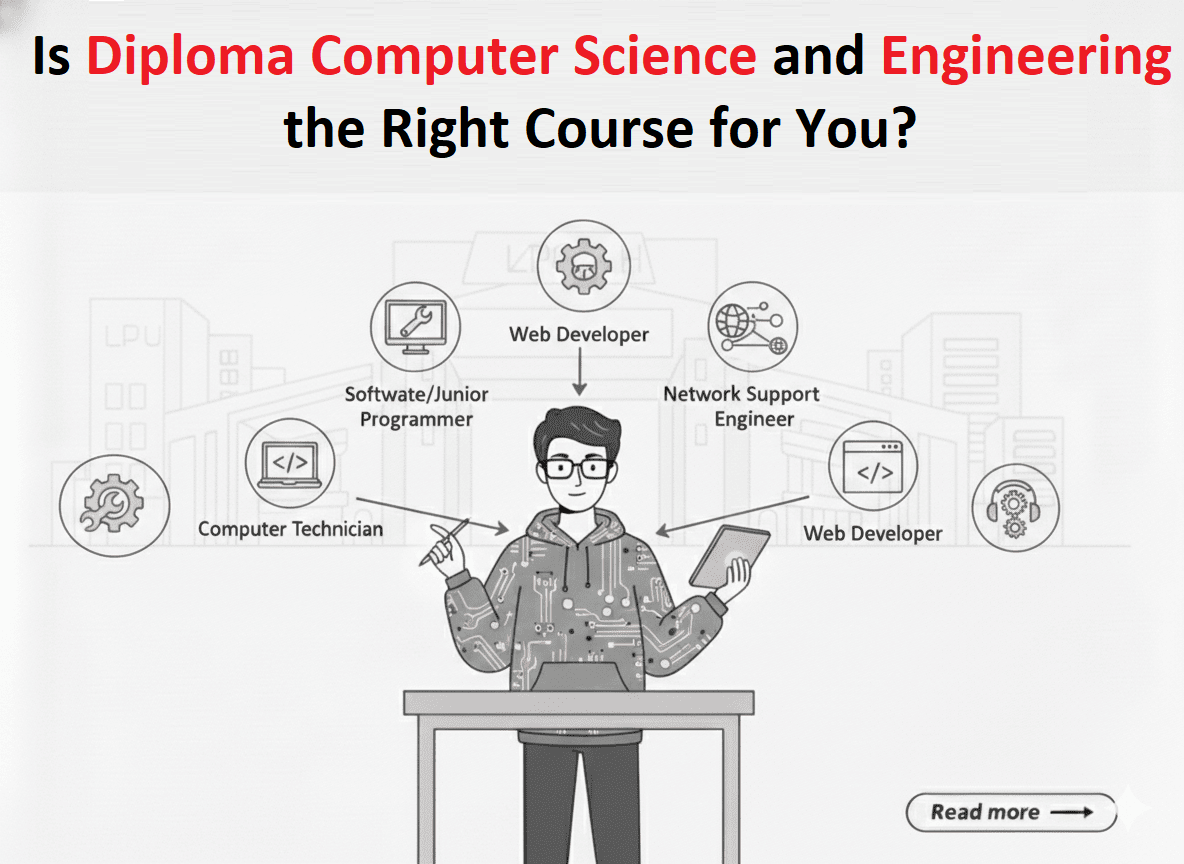
Career Options After Diploma Computer Science and Engineering-
- Computer Technician
- Software/Junior Programmer
- Web Developer
- Network Support Engineer
- IT Support Technician
Whether aiming for immediate employment or planning to pursue higher studies like B.Tech through lateral entry, a CSE diploma offers a solid foundation and opens multiple opportunities for future growth in the ever-expanding world of technology.
With exposure to modern technologies, practical labs, and project work, students become industry-ready by the time they complete the programme.
Who Should Consider a Diploma Computer Science and Engineering?
A Diploma Computer Science and Engineering is designed for students who have completed their 10th standard (or equivalent) and have an interest in computers, technology, and IT-related fields. It is suitable for those who want early career opportunities in software, networking, and hardware or plan to pursue higher studies in computer engineering. Students who enjoy coding, problem-solving, and working with technology can greatly benefit from this programme.
Eligibility Criteria for CSE Diploma
- Educational Qualification: Completion of 10th standard (Matriculation) from a recognized board.
- Minimum Marks: Many institutes require at least 35–50% marks in 10th, though this may vary.
- Entrance Test: Some colleges may conduct an entrance exam or admission may be based on merit in 10th exams.
- Age Limit: Usually 15–20 years, depending on the institution.
Ideal Candidates for a Computer Diploma
- Students interested in computers, programming, and IT systems.
- Learners who enjoy practical, hands-on training rather than purely theoretical studies.
- Those looking for early job opportunities in the IT and technology sectors.
- Students who want to continue higher education later, such as pursuing B.Tech in CSE through lateral entry.
- Individuals who are curious about emerging technologies like networking, web development, and software applications.
The course opens up opportunities for early employment in IT, software, networking, and hardware roles, while also providing a pathway for higher education such as B.Tech in CSE through lateral entry. Overall, it is a strong choice for motivated students seeking a solid foundation in computer science and a promising start to their technical careers.
| Did You Know ?
Many think computer science requires advanced math. In reality, diploma-level CSE mostly needs basic algebra and logical thinking. |
Core Skills You’ll Develop During the Diploma Programme
During a Diploma Computer Science and Engineering, students develop a strong foundation of both technical and practical skills that prepare them for real-world IT roles.
Core Skills You’ll Develop During the Diploma Programme are-
1.Programming Skills
- Learn languages like C, C++, and Python.
- Understand how to write, test, and debug code.
- Develop logical and analytical thinking for problem-solving.
2.Hardware and Networking
- Gain hands-on experience in assembling and troubleshooting computers.
- Understand hardware components such as processors, RAM, and storage.
- Learn networking basics like IP addressing, routing, switching, and network setup.
3.Software Development Skills
- Learn to design and develop basic applications.
- Work with operating systems like Windows and Linux.
- Understand database management using SQL.
- Get introduced to web technologies such as HTML, CSS, and JavaScript.
The programme builds essential software development skills, teaching students how to design applications, work with operating systems, manage databases using SQL, and create simple web interfaces using HTML, CSS, and JavaScript.
These combined skills prepare students to understand both the hardware and software sides of technology, making them capable of handling a wide range of IT tasks.
A Diploma Computer Science and Engineering equips students with a balanced blend of programming expertise, hardware and networking knowledge, and practical software development skills.
This combination helps learners understand technology from the ground up how systems are built, how software runs, and how networks connect everything together.
By mastering both theoretical concepts and hands-on techniques, students become well-prepared for entry-level IT roles and future academic growth, making the diploma a strong foundation for anyone seeking a career in the ever-evolving tech industry.
Benefits of Pursuing a Diploma Computer Science and Engineering
A diploma allows students to enter the tech workforce 2–3 years earlier than traditional degree paths, helping them gain experience and earnings sooner. Opportunities are-
1.Early career opportunities-
Opens doors to jobs like technical support engineer, junior developer, network technician, hardware technician, and IT assistant.
Early exposure to industry helps build experience, confidence, and career growth sooner.
2.Practical Learning Advantages
The curriculum is hands-on, with labs, workshops, and real-world projects.
Students learn to assemble computers, troubleshoot hardware, configure networks, write code, and develop basic software.
3.Overall Diploma Benefits
More affordable and accessible than a full engineering degree.
Ideal for students who prefer skill-based learning over theory-heavy study.
Acts as a strong foundation for continuing education, including lateral entry into B.Tech/B.E.
The course is designed to meet current industry needs, ensuring students learn technologies and skills that employers look for.
With technology evolving rapidly, skills in programming, networking, and software development are always in demand, offering stable and diverse career paths.
A Diploma Computer Science and Engineering at LPU offers students a strong balance of early career opportunities, practical learning, and industry-oriented training. The programme is structured to help students enter the workforce sooner, with many gaining job-ready skills within just three years of study.
With strong academic support, a tech-focused environment, and exposure to professional training, LPU’s Diploma Computer Science and Engineering prepares students for both immediate employment and long-term career growth in the IT field.
| Did You Know ?
LPU’s programme focuses heavily on labs, projects, and workshops, so students spend most of their time applying concepts rather than just reading theory. |
Industries that Actively Hire Diploma Computer Science and Engineering Professionals
Diploma Computer Science and Engineering graduates have a wide range of opportunities across IT, hardware, software, manufacturing, telecom, and public sector industries.
While IT services and software companies offer roles in support, testing, and junior development, hardware-focused and engineering firms provide hands-on positions in embedded systems, network maintenance, and technical support.
IT and hardware/software companies that hire Diploma Computer Science and Engineering professionals, along with the typical roles and industry focus:
| Company / Industry | Role for Diploma Computer Science and Engineering Students |
| HCL Technologies | Technical support, system maintenance, QA, junior developer |
| TCS, Infosys, Wipro | Junior software developer, QA tester, IT support |
| Cyient | Hardware engineer, embedded systems support, testing |
| HAL (Hindustan Aeronautics Ltd.) | Technician, IT maintenance, network admin |
| BHEL (Bharat Heavy Electricals Ltd.) | IT support, system technician |
| Electronics Manufacturing Firms | Assembly technician, circuit testing, embedded system support |
| IT Support / Service Companies | Service engineer, maintenance engineer, helpdesk |
| Telecom Companies (BSNL, Reliance Jio) | Network technician, field engineer, IT support |
| Healthcare IT & EdTech | System admin, technical support, software deployment |
| Automation / Robotics Firms | Automation technician, robotics support engineer |
Advantages of Starting a Career Early with a Diploma Qualification
A diploma allows you to start working early, enter a skill-based career, and hold an industry-ready qualification that employers value. It’s a fast track to earning, gaining experience, and building a professional network while staying competitive.
1. Early Job Opportunities After Diploma
A diploma equips students with practical skills, making them eligible for entry-level positions immediately after graduation. Examples include:
- Engineering & Technology: Junior technician, lab assistant, CAD operator, field engineer.
- IT & Computer Science: Software tester, web developer, network technician, IT support.
- Healthcare: Lab technician, pharmacy assistant, medical imaging assistant, nurse aide.
- Business & Management: Administrative assistant, sales executive, customer service representative.
2.Skill-Based Career
Diplomas focus heavily on practical, hands-on skills rather than theory. This prepares graduates for roles where competence matters more than academic degrees.
- Technical proficiency: Using industry-standard tools, machinery, software, or procedures.
- Soft skills: Communication, teamwork, problem-solving, and time management.
- Certifications & training: Many diploma programmes include industry-recognized certifications, enhancing employability.
3. Industry-Ready Qualification
Diplomas are designed in consultation with industries to meet current market needs.
- Practical curriculum: Includes internships, workshops, and project-based learning.
- Faster adaptation: Graduates can handle real-world tasks without lengthy onboarding.
- Specialization: Fields like mechanical, civil, IT, healthcare, and business administration have diploma courses tailored to industry demands.
| Did You Know ?
Starting a tech career early also helps you build a professional network and gain mentorship, giving you an advantage over peers who pursue longer academic paths. |
Personality Traits and Interests That Match Diploma Computer Science and Engineering
Ideal candidates for a Diploma Computer Science and Engineering are logical, curious, detail-oriented, persistent, and tech-savvy, with an interest in problem-solving, innovation, and teamwork. These traits make it easier to succeed academically and professionally in the fast-paced IT industry.
Personality Traits and Interests That Match Diploma Computer Science and Engineering are-
1. Analytical Mindset
- Relevance: CSE involves understanding algorithms, data structures, and system architectures.
- How it helps: Helps in breaking down complex problems, designing efficient solutions, and debugging code.
- Example: Analyzing why a programme isn’t working and systematically finding the bug.
- Problem-Solving
- Relevance: Core to programming, networking, AI, and software development.
- How it helps: Enables you to tackle real-world tech challenges, optimize systems, and develop practical applications.
- Example: Developing a small app to automate a repetitive task or resolving network connectivity issues.
3. Interest in Technology
- Relevance: CSE is technology-driven, covering software, hardware, and emerging fields like AI, IoT, and cybersecurity.
- How it helps: Keeps you motivated to learn new tools, frameworks, and programming languages.
- Example: Exploring new programming languages, cloud platforms, or IoT devices as part of projects or self-learning.
4. Innovation Skills
- Relevance: Innovation is essential for developing new software, apps, or efficient algorithms.
- How it helps: Allows you to approach problems creatively, design new solutions, and improve existing technologies.
- Example: Creating a unique mobile app or a smart system that solves a common problem in a novel way.
With these traits and interests, a Diploma Computer Science and Engineering isn’t just a good fit it’s ideal. You already have the mindset for coding, problem-solving, tech exploration, and innovation, which are the pillars of success in CSE.
Alumni Success Stories
After a Diploma Computer Science and Engineering, many students take the lateral entry route to B.Tech (or BE), which helps them scale their education and career potential.
The programme designed as a skill enable programme, the students actually learn by doing and progress from basics to higher order skills like develop, install, maintain software and hardware products. Diploma graduates can start entrepreneurial ventures or can pursue higher studies.
Many alumni stress that PCP gave them “basics right” — solid fundamentals in programming, systems, and software engineering. Having a strong foundation allows alumni to later pick up advanced topics (during BE, or at work) more easily.
Almost all the highlighted alumni did diploma → B.E. This is a very common and powerful path, helping them scale their education while not losing the hands-on / practical exposure from diploma.
By doing BE after diploma, they opened doors to larger tech companies, research, and leadership roles.
Others emphasize updating themselves with new technologies, contributing to research, or working on innovative projects.
Many alumni explicitly mention how PCP faculty, infrastructure (labs, project exhibitions), and the college ecosystem were instrumental.
Activities like technical seminars, project exhibitions, and competitions are repeatedly credited.
Some of the student achievements are-
1. Shubham Wadhwa secured first position in Para table tennis national championship-2021 under the aegis of Table Tennis Federation of India.
2. Akash bagged prize for best innovation at International GO Kart event, held at LPU.
3. Lakhwinder Singh placed in an International company- Uflex at a package of 6 L.P.A.
Many alumni used their diploma as a stepping stone to a B.E / B.Tech, which significantly broadened their career opportunities.
The diploma doesn’t just help you enter the tech world — it gives a foundation that enables further academic growth.
Future Growth and Career Possibilities in Computer Science
The field of Computer Science offers vast and dynamic career opportunities for diploma holders and graduates alike. Traditional roles like software development, networking, and database administration provide a solid foundation, while emerging domains such as AI, cybersecurity, cloud computing, IoT, and blockchain open doors to high-growth, high-impact careers.
Career growth in computer science are-
| Role | Skills/Tools |
| Software Developer / Engineer | Java, Python, C++, JavaScript, Git |
| System / Network Administrator | Linux, Windows Server, Networking, Security Basics |
| Database Administrator (DBA) | SQL, Oracle, MySQL, NoSQL |
| Embedded Systems Engineer | C, C++, Microcontrollers, RTOS |
| Artificial Intelligence / Machine Learning Engineer | Python, TensorFlow, PyTorch, ML algorithms |
| Data Scientist / Data Analyst | Python/R, SQL, PowerBI, ML, Statistics |
| Cybersecurity Specialist / Ethical Hacker | Networking, Linux, Pen-testing, CISSP, CEH |
| Cloud Engineer / DevOps Engineer | AWS, Azure, Docker, Kubernetes, CI/CD |
| Blockchain Developer | Solidity, Ethereum, Smart Contracts |
| AI / Robotics Engineer | ROS, Python, C++, AI algorithms |
Career success in CS depends not only on formal education but also on continuous learning, hands-on experience, and skill diversification. Diploma holders can accelerate their growth by pursuing certifications, practical projects, and advanced degrees, leading to senior technical, leadership, or entrepreneurial roles.
CS landscape rewards adaptability, innovation, and problem-solving, making it one of the most promising fields for long-term professional growth and global opportunities.
Conclusion
A Diploma Computer Science and Engineering is an excellent starting point for a rewarding career in technology. It equips students with practical skills to enter the workforce early while keeping doors open for higher education and specialization.
With dedication, hands-on experience, and continuous learning, diploma holders can grow into senior technical roles, leadership positions, or even entrepreneurial ventures.
A Diploma Computer Science and Engineering is a 3-year programme that provides foundational knowledge in:
- Programming languages (C, C++, Java, Python)
- Data structures and algorithms
- Database management
- Networking and operating systems
- Web development, software engineering, and sometimes AI/ML basics
Key Benefits:
- Quick entry into IT and software industry
- Opportunity for internships and hands-on projects
- Eligibility for lateral entry into B.E/B.Tech programmes
- Foundation for specialization in AI, cybersecurity, data science, cloud computing, or IoT.
If you enjoy technology and are committed to learning, a CSE diploma is not just a course it’s a launchpad for a flexible, high-growth, and future-proof career in computing and IT.
Success depends on hands-on experience, continuous learning, and skill diversification.
With dedication, diploma holders can progress to high-paying technical roles, leadership positions, or entrepreneurship, making it a highly future-proof choice in the evolving tech landscape.
With dedication and experience, diploma holders can progress from entry-level positions to senior technical roles, specialized domains, or even leadership and entrepreneurial opportunities, making a CSE diploma a practical and future-proof choice for a rewarding career in computing and IT.
Frequently Asked Questions (FAQ)
1. What is a Diploma Computer Science and Engineering ?
A Diploma Computer Science and Engineering is a 3-year technical programme after 10th grade that focuses on computer programming, software development, networking, database management, and IT fundamentals. It prepares students for entry-level IT jobs and further studies in engineering or technology.
- What is the admission process?
- Direct Admission: Based on 10th-grade marks
- Entrance-Based Admission: Through state-level or institute-level diploma entrance exams.
- Counseling / Merit Lists: Selected students may need to participate in counseling or document verification.
- What is the career scope?
A Diploma Computer Science and Engineering provides a strong foundation for IT careers. Graduates can start with entry-level jobs and progress to senior technical or specialized roles. The field is evolving rapidly, with high demand in software development, AI, data science, cybersecurity, cloud computing, and IoT, making it a future-proof career option.
- What subjects are taught?
Programming Languages (C, C++, Java, Python), Data Structures & Algorithms, Database Management (SQL, MySQL, NoSQL), Computer Networks & Operating Systems, Web & Mobile App Development.
5. Is a Diploma Computer Science and Engineering enough for IT careers?
Yes, for entry-level positions. For specialized roles or senior positions, higher studies, certifications, and experience are recommended.


![Career Paths after B.Sc. Information Technology [Lateral Entry]](https://www.lpu.in/blog/wp-content/uploads/2026/01/Career-Paths-after-B.Sc_.-Information-Technology-Lateral-Entry-218x150.png "Career Paths After B.Sc. Information Technology [Lateral Entry]")