
- Why Choosing the Right Course Matters?
- What Is B.Sc. (Interior and Furniture Design)?
- Who Should Consider B.Sc. (Interior and Furniture Design)?
- Why Interior and Furniture Design Is a Game-Changer?
- Top Skills You’ll Develop in B.Sc. (Interior and Furniture Design)
- Industry Demand and Future Prospects
- Internship & Project Opportunities
- Alumni Success Stories
- Design Competitions, Exhibitions, and Showcases
- How to Maximize Your Career in Interior and Furniture Design?
- Conclusion
- Frequently Asked Questions (FAQs)
Why Choosing the Right Course Matters?
Choosing the right undergraduate programme is one of the most defining decisions in a student’s academic journey. The process of choosing the right degree goes far beyond selecting a course based on trends or peer influence. It requires self-reflection, awareness of industry growth, and understanding long-term professional aspirations. The importance of course selection cannot be overstated, especially in creative fields where passion and skill development go hand in hand.
When it comes to interior design career decisions, students often wonder whether creativity alone is enough, or whether technical knowledge and structured education are equally essential. In today’s evolving design landscape, interior and furniture design is not limited to decoration. It involves space planning, ergonomics, sustainability, digital modeling, construction detailing, and human-centered design thinking.
A well-structured programme such as B.Sc. (Interior and Furniture Design) helps students transform their artistic interests into professional competence. Instead of learning design informally, students gain exposure to materials, lighting science, furniture construction, CAD tools, and sustainable practices under academic mentorship.
Making an informed choice today can shape your creative identity, financial independence, and long-term career satisfaction tomorrow.
| Did You Know?
The global interior design industry is projected to grow steadily over the next decade due to rapid urbanization, real estate expansion, and the increasing demand for customized residential and commercial spaces. |
What Is B.Sc. (Interior and Furniture Design)?
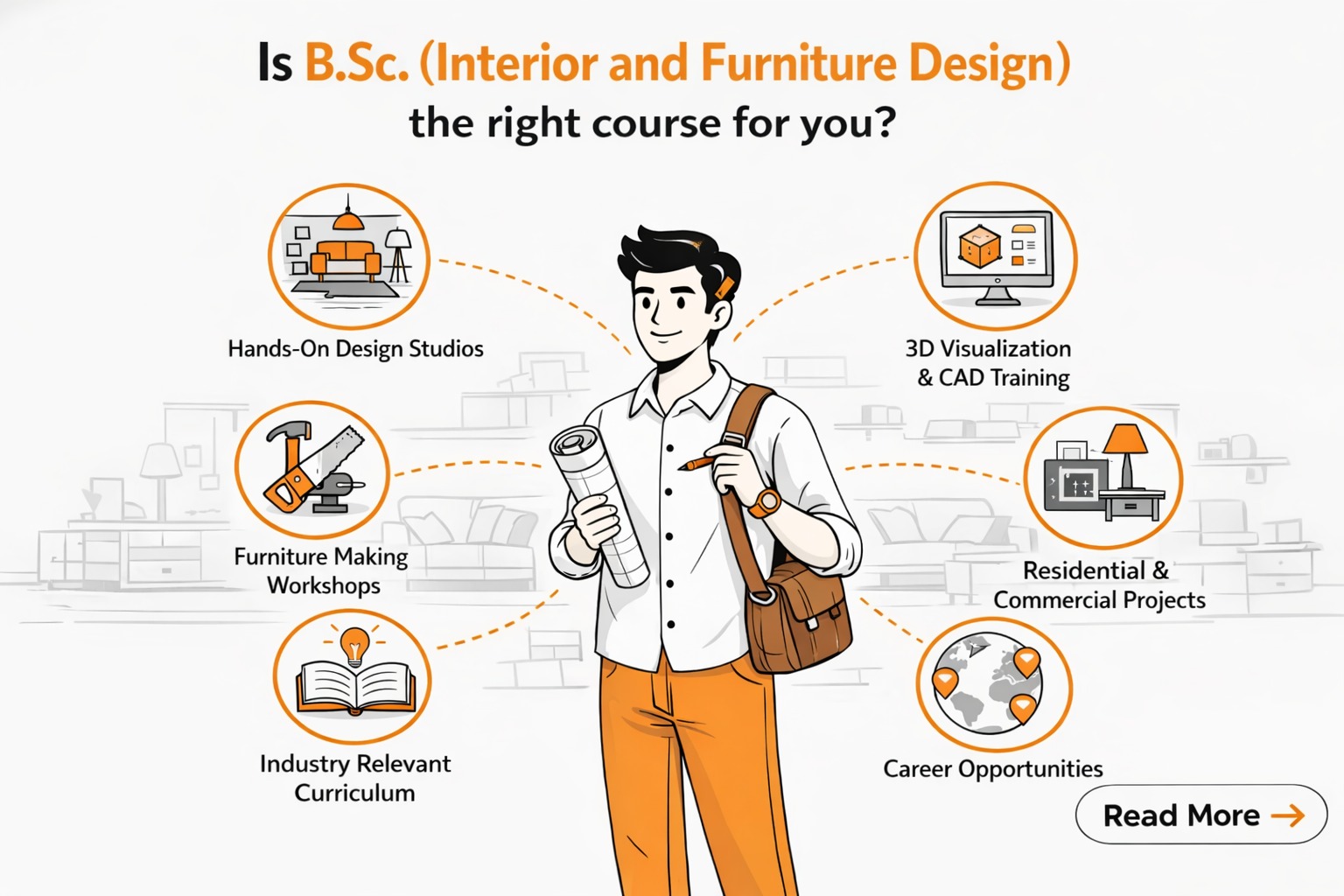
Many students ask: what is interior and furniture design in an academic sense? The B.Sc. Interior and Furniture Design is a structured undergraduate programme that combines creative exploration with technical precision. Unlike short-term certification courses, this degree provides a comprehensive interior design degree overview, covering conceptual development, spatial planning, materials, construction techniques, furniture detailing, and digital visualization.
When exploring B.Sc interior design course details, students discover that the curriculum blends art and engineering principles. You study color psychology, lighting systems, ergonomics, furniture joinery, 3D modeling software, sustainable design methods, and project management basics. The programme ensures that students not only imagine beautiful spaces but also understand how to execute them in real-world contexts.
Interior and furniture design are interconnected disciplines. While interior design focuses on spatial aesthetics and functionality, furniture design emphasizes construction, structural stability, detailing, and material innovation. A dual-focused programme gives graduates a competitive edge by providing both conceptual and practical mastery.
This degree prepares students for both corporate employment and entrepreneurial ventures in design consultancy.
Who Should Consider B.Sc. (Interior and Furniture Design)?
A common concern among students is: who should study interior design? This programme is ideal for individuals who possess creativity, spatial imagination, and a keen eye for detail. If you enjoy rearranging spaces, sketching layouts, experimenting with materials, or visualizing room transformations, this field may align with your interests.
When evaluating eligibility for interior design, most universities require completion of 10+2 from a recognized board. However, the real eligibility lies in your curiosity, dedication, and willingness to experiment.
If you often ask yourself, is interior design right for me, consider the following:
- Do you enjoy creative problem-solving?
- Are you observant of textures, lighting, and color combinations?
- Do you like blending aesthetics with functionality?
- Are you comfortable working with digital tools and software?
The ideal candidates for furniture design are those who are equally interested in structural detailing, craftsmanship, and product innovation.
Interior and furniture design is not just about creativity; it is about applying logic to artistic vision.
Why Interior and Furniture Design Is a Game-Changer?
The benefits of interior design career opportunities have expanded tremendously over the past decade. With increasing urban infrastructure, smart city initiatives, hospitality growth, and luxury housing demand, the design industry growth curve remains upward.
Students often ask: why choose interior and furniture design over traditional fields? The answer lies in versatility and creative freedom. This profession allows you to:
- Work independently or in corporate environments
- Combine art, psychology, and engineering
- Influence how people experience spaces
- Contribute to sustainable and functional environments
The demand for designers continues to increase across residential, retail, commercial, healthcare, and hospitality sectors.
Interior designers today are not decorators; they are spatial strategists who enhance productivity, comfort, and well-being through thoughtful design.
Top Skills You’ll Develop in B.Sc. (Interior and Furniture Design)
This programme equips students with both artistic and technical capabilities. The essential interior design skills include space planning, color coordination, and conceptual thinking.
Students also gain strong CAD skills, learning tools such as AutoCAD, SketchUp, 3ds Max, and Revit. These software skills are critical in today’s professional environment.
The creativity skills for designers extend beyond imagination. Students learn to present concepts visually, pitch ideas confidently, and convert abstract thoughts into practical designs.
On the technical side, furniture design technical skills include joinery methods, structural detailing, material testing, ergonomics, and prototyping.
These combined skills make graduates adaptable and industry-ready.
| Did You Know?
Over 70% of design hiring today is portfolio-based, emphasizing practical work over theoretical grades. |
Industry Demand and Future Prospects
The future of interior design looks promising due to technological advancements, sustainable building practices, and lifestyle evolution.
The industry demand for designers spans across:
- Real estate and luxury housing
- Retail and commercial showrooms
- Hotels and hospitality chains
- Healthcare facilities
- Smart workspace development
The scope of furniture design has expanded into modular systems, ergonomic office setups, and eco-friendly material innovation.
The interior design job market is becoming more globalized, offering opportunities both domestically and internationally.
Internship & Project Opportunities
Practical exposure is essential. Students gain access to internships in interior design, allowing them to work with design studios and construction firms.
Through live projects for design students, they experience client interaction, budgeting, site visits, and execution planning.
Such practical design training bridges academic learning with professional expectations.
Alumni Success Stories
The true measure of a programme lies in its graduates. Interior design alumni success stories highlight professionals working in reputed firms or running independent consultancies.
Many graduate career stories demonstrate how structured education accelerates professional growth.
Design Competitions, Exhibitions, and Showcases
Participating in interior design competitions enhances confidence and exposure.
Design exhibitions and student showcases allow learners to present portfolios to industry experts.
Such portfolio development events strengthen professional identity.
How to Maximize Your Career in Interior and Furniture Design?
To succeed, follow strategic career tips for interior designers:
- Continuously upgrade software knowledge
- Build a diverse portfolio
- Network with architects and contractors
- Stay updated with global trends
Understanding how to grow as a designer requires adaptability and lifelong learning.
Strong interior design career strategies combine technical expertise with business awareness.
| Did You Know?
Freelancing in interior design can often generate higher income once a designer builds strong client referrals. |
Conclusion
The future in interior design is dynamic and promising. If you are passionate about creativity, problem-solving, and spatial innovation, this could be your ideal path.
When asking, is interior and furniture design worth it, the answer depends on your commitment to growth and skill enhancement.
With industry demand rising and technology reshaping design processes, this degree offers both artistic fulfillment and financial stability.
Frequently Asked Questions (FAQs)
Q1. What is the duration of B.Sc. (Interior and Furniture Design)?
Ans: Typically 3 years, divided into 6 semesters.
Q2. What software skills are taught?
Ans: Students learn AutoCAD, SketchUp, 3ds Max, and Revit.
Q3. What is the scope after graduation?
Ans: Roles include Interior Designer, Furniture Designer, Visualizer, and Design Consultant.
Q4. Are internships compulsory?
Ans: Most structured programmes include internships for industry exposure.
Q5. Is the course suitable for students from non-design backgrounds?
Ans: Yes, foundational modules build skills from the beginning.




![Career Paths after B.Sc. Information Technology [Lateral Entry]](https://www.lpu.in/blog/wp-content/uploads/2026/01/Career-Paths-after-B.Sc_.-Information-Technology-Lateral-Entry-100x70.png "Career Paths After B.Sc. Information Technology [Lateral Entry]")