- Why Career Planning After a Diploma Matters?
- Inside the Diploma Computer Science and Engineering: Course Overview and Highlights
- Core Skills and Technical Knowledge You Gain from a CSE Diploma
- CSE Applications Across Industries: IT, Banking, Healthcare, and Education
- Entry-Level Job Roles After a Diploma in Computer Science and Engineering
- Career Opportunities in Web Development, Cloud, and Data Analytics
- Government and PSU Opportunities for CSE Diploma Holders
- Pathways for Higher Studies After a Diploma (B.Tech., AMIE, Lateral Entry, etc.)
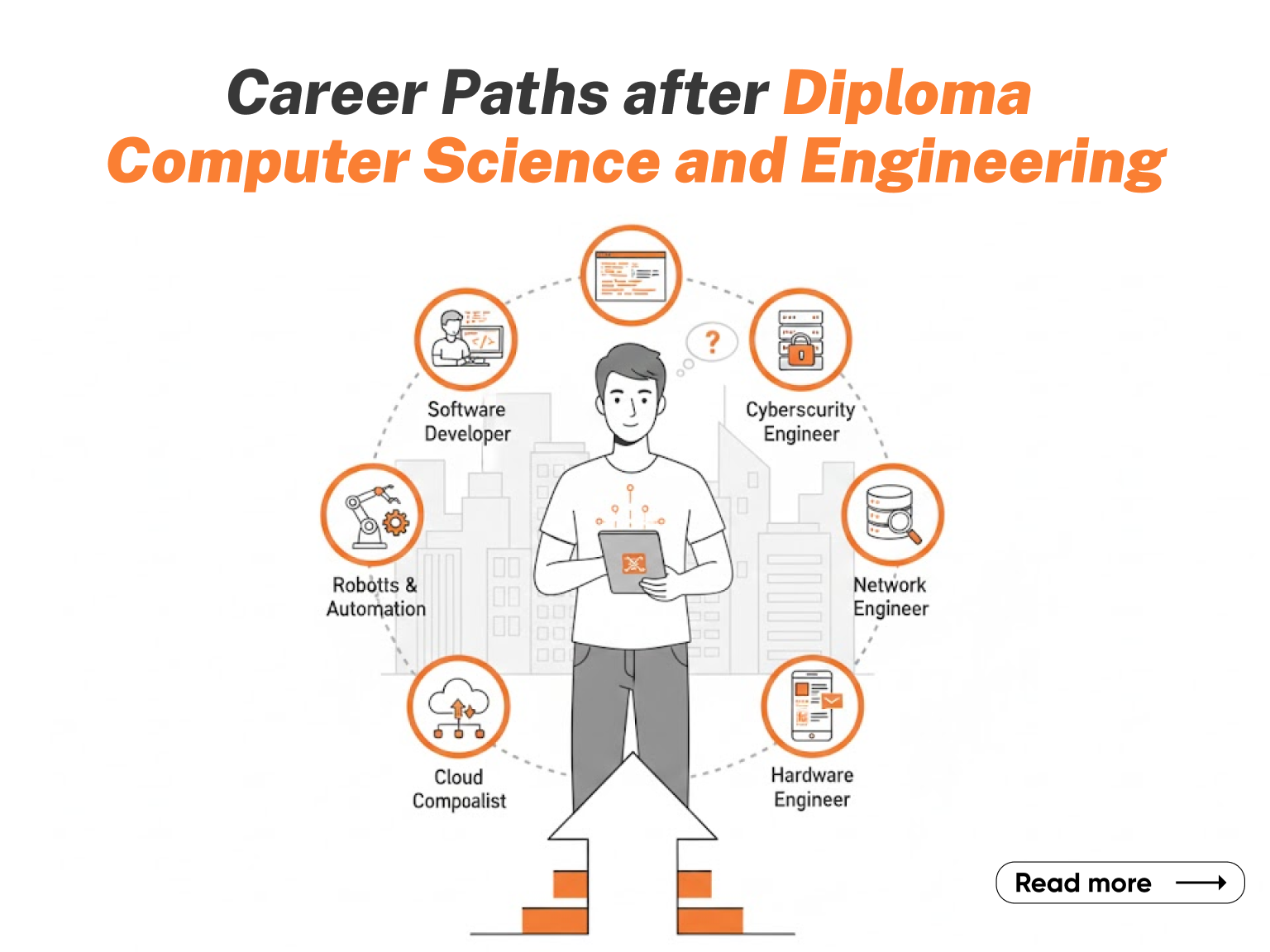
- Emerging Careers in Cybersecurity, AI, IoT, and Robotics
- Entrepreneurship and Startup Opportunities in CSE
- Final Thoughts
- Frequently Asked Questions (FAQ)
Why Career Planning After a Diploma Matters?
Completing a diploma is a significant milestone it represents years of hard work, dedication, and the acquisition of specialized skills.
Earning a diploma is not the final step in one’s professional journey; it’s the beginning of a broader career path.
Career planning after a diploma helps students make informed choices about what comes next whether it’s pursuing higher education, entering the job market, or developing entrepreneurial ventures.
For Diploma Computer Science and Engineering graduates, career planning is especially important. The technology industry evolves rapidly, and having a well-defined roadmap ensures that students keep pace with new trends like artificial intelligence, cybersecurity, data science, and software development.
Career planning after completing a diploma is a crucial step toward building a successful professional life. A diploma provides students with technical knowledge and practical skills, but deciding how to apply those skills is equally important.
Proper career planning helps diploma holders identify their strengths, set clear goals, and choose the right path—whether that’s pursuing higher studies, gaining industry experience, or starting their own business.
Importance of Diploma Career Planning
Effective diploma career planning allows students to make informed decisions about their future. It helps them understand current job market trends, explore different career options, and develop skills that are in high demand.
Planning also boosts confidence, ensures better time management, and prevents uncertainty about what to do next. With a clear vision, diploma graduates can align their education with long-term career success.
For computer science diploma students in particular, continuous learning and adaptation to new technologies are key to staying competitive in a rapidly changing digital world. With proper career planning, diploma graduates can confidently build a strong and successful future.
By understanding personal interests, industry trends, and growth opportunities, diploma holders can make smart choices that lead to rewarding careers.
Inside the Diploma Computer Science and Engineering : Course Overview and Highlights
The Diploma Computer Science and Engineering is a technical programme designed to equip students with fundamental knowledge of computer systems, software development, and digital technologies.
This course bridges the gap between theoretical concepts and practical applications, preparing students for entry-level positions in the IT industry or for higher education in engineering and technology fields.
The course provides a strong foundation in computer systems, programming languages, and emerging technologies while balancing theoretical and practical learning.
- The eligibility criteria require students to have passed the 10th standard with subjects like Mathematics, Science, and English, with at least 50% marks in aggregate.
- LPU also offers a lateral entry option into the second year for students who have completed an ITI, a two-year technical diploma, or a 10+2 vocational course.
- The programme is spread over six semesters and includes subjects such as Computer Programming (C, C++, Python, Java), Data Structures, Operating Systems, Database Management Systems (DBMS), Web and Mobile App Development, Computer Networks, Digital Electronics, and Microprocessors. Students also gain exposure to cloud computing, IoT, and cybersecurity through electives.
The curriculum emphasizes practical learning through lab sessions, mini-projects, internships, and a final-year major project to ensure students are industry-ready.
LPU’s Diploma Computer Science and Engineering is known for its industry-oriented approach, advanced infrastructure, and opportunities for hands-on learning. The university provides access to modern computer labs, workshops, and industry collaborations, allowing students to gain real-world experience.
LPU’s Diploma Computer Science and Engineering equips students with technical expertise, professional skills, and confidence to excel in the rapidly evolving technology-driven world.
This diploma acts as a strong foundation for young aspirants who wish to begin their journey in technology and engineering, equipping them with the confidence, skills, and opportunities to excel in a rapidly evolving global tech landscape.
Core Skills and Technical Knowledge You Gain from a Diploma Computer Science and Engineering
A Diploma Computer Science and Engineering provides students with a solid foundation in both technical knowledge and practical skills essential for success in the fast-growing field of information technology.
Throughout the course, students not only learn the principles of computing and programming but also develop problem-solving abilities, analytical thinking, and technical competence that prepare them for real-world challenges.
1. Programming and Software Development
Students gain proficiency in multiple programming languages such as C, C++, Java, and Python. They learn how to write efficient code, debug programmes, and design software applications. This skill forms the backbone of careers in software development, web design, and app creation.
2. Data Structures and Algorithms
Understanding how data is organized, processed, and accessed is a crucial part of the CSE diploma. Students learn about different algorithms and data structures that enhance the performance and efficiency of software systems.
3. Database Management
The course teaches the fundamentals of Database Management Systems (DBMS), including SQL, data modeling, and database design. These skills help students manage and retrieve data efficiently in business and technical environments.
4. Computer Networks and Operating Systems
Students explore how computers communicate and how operating systems function. They gain knowledge of network protocols, IP addressing, network security, and resource management, which are essential for roles in networking and IT support.
The course also emphasizes database management, teaching students how to design, organize, and manage large volumes of data using tools like SQL and DBMS. Altogether, these skills prepare diploma holders to become competent IT professionals ready to take on real-world challenges in software, networking, and data-driven industries.
A Diploma Computer Science and Engineering equips students with a blend of core computing knowledge, hands-on technical skills, and professional competencies. These capabilities enable graduates to adapt to various roles in the IT sector ranging from software and web development to networking, system management, and further engineering studies.
CSE Applications Across Industries: IT, Banking, Healthcare, and Education
A Diploma Computer Science and Engineering equips students with versatile skills that are in high demand across multiple industries. Its applications extend far beyond traditional IT roles, influencing sectors like banking, healthcare, and education.
1. Information Technology (IT)
The IT industry is the most direct application of CSE skills. Diploma holders can work as software developers, web designers, mobile app developers, or system administrators. Programming, software development, and networking knowledge gained during the course allow students to create, maintain, and secure complex digital systems and applications.
2. Banking and Finance
Banks and financial institutions rely heavily on computer systems for transaction processing, data management, cybersecurity, and online banking solutions. CSE graduates can contribute by managing databases, developing financial software, ensuring network security, and analyzing data to improve services.
3. Healthcare
Healthcare technology is rapidly evolving with digital patient records, telemedicine, and medical software applications. Diploma Computer Science and Engineering holders can develop healthcare management systems, work on data analytics for patient care, or implement secure networks for hospitals, thereby improving efficiency and accuracy in medical services.
4. Education
In the education sector, CSE applications range from online learning platforms to educational software and virtual classrooms. Diploma holders can design e-learning applications, maintain IT infrastructure, and implement data-driven tools that enhance teaching, learning, and administration.
A Diploma Computer Science and Engineering provides transferable technical skills that are relevant in almost every industry. Whether it’s developing software, managing networks, analyzing data, or ensuring cybersecurity, the knowledge gained opens diverse career pathways and makes graduates valuable contributors in multiple sectors.
The combination of programming, software development, networking, and database management skills ensures that graduates are prepared to meet industry demands, enhance operational efficiency, and adapt to evolving technological trends.
Ultimately, a Diploma Computer Science and Engineering provides a strong foundation for both immediate employment and further academic advancement, empowering students to build successful and versatile careers in multiple sectors.
Entry-Level Job Roles After a Diploma Computer Science and Engineering
A Diploma Computer Science and Engineering opens up several entry-level career opportunities in the IT and technology sector.
The programme equips students with essential skills such as programming, software development, networking, database management, and problem-solving, making them suitable for technical roles across industries.
Top entry-level jobs after a Diploma Computer Science and Engineering, including their roles and approximate starting salaries:
| Job Role | Job Description |
| Software Tester / QA Tester | Test software applications, identify bugs, and ensure proper functionality. |
| Junior Developer / Programmer | Assist in developing and maintaining software applications using languages like C, C++, Java, or Python. |
| Technical Support Engineer / IT Support | Troubleshoot hardware and software issues, maintain IT systems, and provide client support. |
| Web Developer (Junior) | Design, develop, and maintain websites or web applications using HTML, CSS, JavaScript, etc. |
| Database Administrator (Junior) | Manage and maintain databases, perform backups, and support senior DBAs. |
| Network Administrator / Support | Maintain computer networks, configure devices, and ensure network security. |
| System Analyst (Junior) | Assist in analyzing IT systems, gathering requirements, and implementing software solutions. |
| IT Trainee / Intern | Gain hands-on experience with software, networking, and IT infrastructure through training programmes. |
A Diploma Computer Science and Engineering opens the door to a variety of entry-level IT careers. Graduates can pursue roles such as software tester, junior developer, technical support engineer, web developer, and network administrator, among others.
Career Opportunities in Web Development, Cloud, and Data Analytics
A Diploma Computer Science and Engineering equips students with technical skills that are highly relevant in modern IT domains such as web development, cloud computing, and data analytics. These areas are experiencing rapid growth, offering a wide range of career opportunities for diploma holders.
Career opportunities for Diploma Computer Science and Engineering graduates in Web Development, Cloud Computing, Data Analytics, and other IT jobs:
| Career Domain | Job Role |
| Web Development | Web Developer / Front-End / Back-End / Full-Stack Developer |
| Cloud Computing | Cloud Support Engineer / Cloud Administrator / Junior Cloud Developer |
| Data Analytics | Junior Data Analyst / BI Analyst / Reporting Specialist |
| Software Development | Junior Software Developer / Programmer |
| Technical Support / IT | Technical Support Engineer / IT Support / Network Administrator |
| Quality Assurance | Software Tester / QA Tester |
Web development, cloud computing, and data analytics offer promising career paths for CSE diploma graduates.
These domains not only provide lucrative job opportunities but also allow professionals to work on innovative projects, enhance technical expertise, and prepare for higher roles in software development, cloud architecture, or data science.
In essence, a Diploma Computer Science and Engineering prepares graduates for diverse IT careers, ranging from web and software development to cloud computing and data analytics. These roles not only offer entry-level opportunities but also serve as stepping stones toward advanced positions in the rapidly evolving technology industry.
With practical knowledge in programming, networking, database management, and software development, diploma holders are well-prepared to start their careers, grow professionally, and adapt to the evolving demands of the IT sector.
Government and PSU Opportunities for Diploma Computer Science and Engineering Holders
A Diploma Computer Science and Engineering not only opens doors in private IT companies but also provides promising career opportunities in government organizations and Public Sector Undertakings (PSUs).
These roles are highly valued for their job security, structured growth, and attractive benefits, making them a popular choice among diploma graduates.
Government and PSU opportunities for Diploma Computer Science and Engineering holders:
| Sector | Job Roles | Responsibility |
| Government IT Jobs | IT Technician / IT Support Staff | Maintain computer systems, troubleshoot hardware/software, assist users. |
| Junior System Operator / Network Assistant | Manage networks, servers, and digital infrastructure. | |
| Software Assistant | Support software applications and e-governance projects. | |
| PSU Opportunities | Junior Engineer (IT) | Maintain IT infrastructure, manage networks, and industrial software systems. |
| Technical Assistant / System Operator | Monitor systems, assist in IT operations, ensure security compliance. | |
| Network Administrator | Configure and manage LAN/WAN networks, servers, and communication systems. | |
| IT Trainee / Intern | Gain hands-on experience with IT infrastructure and projects in PSU environment. |
A Diploma Computer Science and Engineering provides valuable opportunities in government organizations and Public Sector Undertakings (PSUs).
Roles such as IT Technician, Junior Engineer (IT), Network Administrator, and Software Assistant allow diploma holders to apply their technical skills in real-world IT environments while enjoying job security, structured career growth, and attractive benefits.
Pathways for Higher Studies After a Diploma (B.Tech., AMIE, Lateral Entry, etc.)
Completing a Diploma Computer Science and Engineering provides a solid technical foundation, but many graduates choose to pursue higher education to enhance career prospects, increase earning potential, or specialize in advanced domains. Several pathways are available:
1. B.Tech / BE via Lateral Entry
Diploma holders can directly enter the second year of a B.Tech or BE programme in computer science or related fields through lateral entry schemes offered by many universities. This allows students to earn a bachelor’s degree in a shorter time (typically 3 years instead of 4) and qualify for higher-level roles in IT, software development, or core engineering.
2. AMIE (Associate Member of the Institution of Engineers)
The AMIE programme offers a flexible, part-time pathway to earn an equivalent B.E./B.Tech degree, recognized by the Government of India and many PSUs. It is ideal for diploma holders who want to continue working while pursuing higher education and obtain a recognized engineering degree without leaving their jobs.
3. Bachelor’s Programmes in IT, Computer Science, or Software Engineering
Diploma graduates can also pursue specialized bachelor’s programmes in IT, computer science, or software engineering at various institutes. These programmes help students strengthen theoretical knowledge, gain exposure to emerging technologies, and enhance career opportunities in software development, cloud computing, and data analytics.
4. Certification and Skill-Based Courses
Apart from formal degrees, diploma holders can enhance their qualifications through certification courses in programming, networking, cloud computing, cybersecurity, AI, and data analytics. These certifications improve employability, prepare graduates for specialized roles, and can complement higher education pathways.
A Diploma Computer Science and Engineering serves as a stepping stone for higher studies, offering multiple pathways like B.Tech/BE via lateral entry, AMIE, specialized bachelor’s programmes, and skill-based certifications. These options allow diploma holders to advance academically, specialize in emerging technologies, and access higher-paying roles in IT, software, and engineering sectors.
| Did You Know ?
Many PSUs and government organizations recruit diploma holders directly for technical roles, offering secure jobs with structured career growth. |
Emerging Careers in Cybersecurity, AI, IoT, and Robotics
With the rapid evolution of technology, new and exciting career opportunities have emerged for graduates in Computer Science and Engineering (CSE). Diploma holders who upskill in modern technologies can access high-demand roles in cybersecurity, artificial intelligence (AI), the Internet of Things (IoT), and robotics.
Cybersecurity professionals are in high demand due to increasing cyber threats and data breaches. Career roles include:
- Cybersecurity Analyst / Ethical Hacker / Security Consultant
- Responsibilities: Protect networks, monitor for threats, conduct penetration testing, and implement security protocols.
AI is transforming industries from healthcare to finance. Diploma holders can pursue roles such as:
- AI/ML Developer, Data Scientist, or AI Research Assistant
- Responsibilities: Develop AI models, implement machine learning algorithms, and work on automation solutions.
IoT is connecting devices to create smarter environments. Opportunities include:
- IoT Developer / Embedded System Engineer / IoT Analyst
- Responsibilities: Design IoT devices, programme sensors, collect and analyze device data, and integrate systems.
Robotics combines hardware and software to automate tasks across industries. Career roles include:
- Robotics Engineer / Automation Technician / Robotics Programmer
- Responsibilities: Design and programme robots, develop control systems, and implement automation solutions in manufacturing, healthcare, and defense.
| Did You Know ?
Diploma holders in CSE can pursue AI, cloud computing, and cybersecurity certifications to qualify for high-paying, in-demand jobs even before completing a bachelor’s degree. |
Entrepreneurship and Startup Opportunities in CSE
CSE diploma holders have a wide range of tech entrepreneurship opportunities. By leveraging their skills in software development, AI, IoT, robotics, web services, and cybersecurity, they can start small IT businesses or freelance ventures, contribute innovative solutions to the market, and build profitable, scalable startups.
1. Software and App Development Startups
Diploma holders can create custom software solutions, mobile applications, or SaaS (Software as a Service) products.
2. Web Development and Digital Solutions
Starting a web development or digital solutions company is a viable option.
3. AI, Data Analytics, and Machine Learning Startups
With the rise of AI and data-driven decision-making, diploma holders can start ventures in Predictive analytics solutions for businesses.
4. IoT and Robotics Ventures
IoT and robotics offer opportunities to develop innovative hardware-software integrated solutions, Smart home or smart city devices.
5. Freelancing and Remote Tech Services
Many diploma holders start their entrepreneurial journey by freelancing, offering-Software and app development.
The field of CSE offers immense entrepreneurial potential. Diploma holders can launch startups in software, web development, AI, IoT, robotics, and digital solutions, leveraging their technical skills to create innovative products and services.
With proper planning, skill development, and market understanding, CSE graduates can transform ideas into successful businesses, contributing to both personal growth and technological innovation.
With creativity, continuous learning, and strategic planning, a Diploma Computer Science and Engineering can serve as a launchpad for a successful entrepreneurial career.
Entrepreneurship offers diploma holders in CSE a pathway to independence, creativity, and financial growth.
By venturing into software, AI, IoT, robotics, cybersecurity, EdTech, or freelancing, graduates can turn technical skills into profitable business ideas. With determination, continuous learning, and an understanding of market trends, a diploma in CSE can be the foundation for a successful entrepreneurial career in the technology sector.
Final Thoughts
A Diploma Computer Science and Engineering opens a world of opportunities for both immediate employment and long-term career growth.
Diploma holders acquire strong technical skills in programming, networking, database management, software development, and emerging technologies, making them highly employable across industries such as IT, banking, healthcare, education, and government sectors.
The career scope after a Diploma Computer Science and Engineering is diverse and dynamic. Graduates can pursue entry-level roles like software testers, junior developers, IT support engineers, or specialize in high-growth domains such as AI, IoT, robotics, cloud computing, cybersecurity, and data analytics. Additionally, diploma holders have the option to advance their education through lateral entry into B.Tech programmes, AMIE certifications, or other higher studies, enhancing both knowledge and career prospects.
The importance of a Diploma Computer Science and Engineering in future tech cannot be overstated. As industries continue to adopt automation, digitalization, and smart technologies, skilled professionals with a CSE background will be at the forefront of innovation. The diploma equips graduates not only for technical excellence but also for entrepreneurship, freelancing, and startup ventures, allowing them to contribute actively to the technology-driven economy.
In essence, a Diploma Computer Science and Engineering serves as a launchpad for a promising career, providing both practical skills and strategic opportunities in the rapidly evolving world of technology. With continuous learning, upskilling, and adaptability, diploma holders can build a rewarding and future-proof career in the tech landscape.
A Diploma Computer Science and Engineering offers a strong foundation for a successful and future-ready career. It equips graduates with essential technical skills in programming, networking, software development, and emerging technologies, making them highly employable across diverse industries.
Beyond traditional job roles, diploma holders can explore specialized domains like AI, IoT, robotics, cybersecurity, and data analytics, pursue higher studies, or venture into entrepreneurship and startups. In today’s technology-driven world, a Diploma Computer Science and Engineering not only opens immediate career opportunities but also serves as a launchpad for long-term growth and innovation.
Frequently Asked Questions (FAQ)
- What is a Diploma Computer Science and Engineering ?
A Diploma Computer Science and Engineering is a technical programme that provides practical knowledge in programming, networking, database management, software development, and computer engineering concepts. It is typically a 3-year course after 10th or 12th depending on the education system.
- What subjects are covered in a Diploma Computer Science and Engineering ?
Key subjects include: Programming languages (C, C++, Java, Python), Database Management Systems (DBMS), Networking and Internet Technologies, Software Development and Engineering, Cybersecurity basics, etc. - What are the job options after a Diploma Computer Science and Engineering ?
Diploma holders can pursue various roles in IT and technology sectors, including- Junior Software Developer, Software Tester / QA Analyst, Technical Support Engineer, Web Developer / Front-End Developer, Database Administrator (Junior Level). - Are there government or PSU job opportunities for Diploma Computer Science and Engineering holders?
Yes, diploma holders can apply for- IT Technician / Technical Officer roles in government departments, PSU jobs in IT, networking, and technical services, State and central government IT positions through entrance exams. - How important is practical experience and certifications?
Practical skills and certifications significantly enhance employability. Internships, freelancing, and certifications in AI, cloud, cybersecurity, and web development help graduates stand out in competitive job markets.




![Is B.Tech. Aerospace Engineering [Lateral Entry] the Right Course for You?](https://www.lpu.in/blog/wp-content/uploads/2025/10/B-Tech-Aerospace-Engineering-Lateral-Entry-03-1.png "Is B.Tech. Aerospace Engineering [Lateral Entry] the Right Course for You?")