
- Understanding Your Future: Why Career Direction Matters After a CE Diploma?
- What You Study in a Civil Engineering Diploma: Structure & Key Learning Areas
- Practical and Technical Competencies You Develop in CE
- How Civil Engineers Shape Growth in Public & Private Infrastructure?
- Early Career Job Profiles for Civil Diploma Graduates
- Design, Construction Management & Quality Roles in Civil Engineering
- Government Sector Careers and PSU Recruitment for Diploma Holders
- Advancing Education: Options for Further Studies After CE Diploma
- High-Potential Careers in Smart Infrastructure and New-Age Civil Tech
- Entrepreneurial Prospects in the Civil Engineering Landscape
- Final Insights: The Impact of a CE Diploma in Modern Industry
- Frequently Asked Questions (FAQs)
Understanding Your Future: Why Career Direction Matters After a CE Diploma?
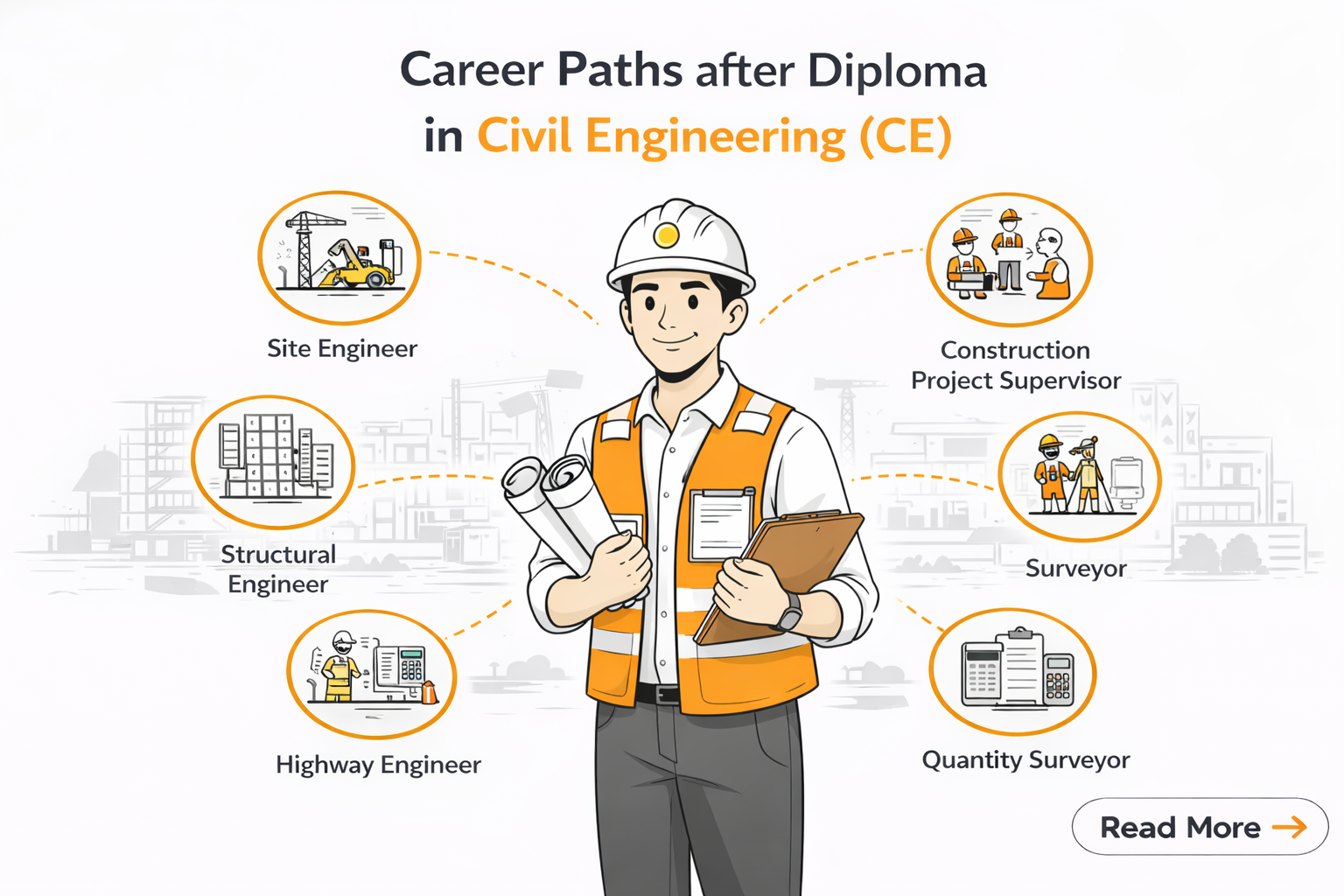
Completing a Diploma Civil Engineering (CE) is an important achievement, but it is only the beginning of your professional journey. At this stage, many students feel confused about what to do next because there are multiple career paths after diploma civil engineering available. Without a clear direction, it is easy to choose options that may not match your interests or long-term goals. That is why planning your next step carefully is essential.
The transition from student life to the professional world requires more than technical knowledge. You need to understand how your skills fit into real industry roles such as site supervision, quantity surveying, drafting, or project assistance. Proper civil engineering diploma career guidance helps you evaluate these opportunities and select a path that supports growth, learning, and stability rather than just immediate employment.
When students make decisions without planning, they may end up in roles that offer limited exposure or slow career progression. A focused approach allows you to build expertise step by step, gain relevant field experience, and prepare for higher responsibilities in construction and infrastructure projects. Choosing the right direction early helps you avoid wasting time and ensures that each job adds value to your professional profile.
Today, technology is also playing a key role in helping students make smarter decisions. Tools that support AI-based career planning for civil engineers can analyse industry trends, required skills, and future demand to suggest suitable career options. This enables diploma holders to align their abilities with emerging opportunities in modern construction and development sectors.
Ultimately, your diploma is a foundation-but your career is shaped by the choices you make afterward. By understanding the available career paths after diploma in civil engineering and seeking the right guidance, you can confidently move from education into a structured, rewarding professional journey.
| Did You Know ?
Civil Engineering diploma holders who choose structured career planning and skill-based training programmes often grow faster in their careers than those who take up jobs without a clear plan. |
What You Study in a Civil Engineering Diploma: Structure & Key Learning Areas ?
A Civil Engineering diploma is structured to provide a balanced mix of theoretical knowledge and practical application, ensuring that students develop the technical competence required in the construction and infrastructure industries. The civil engineering diploma syllabus in LPU is carefully designed to introduce fundamental engineering concepts first and then gradually build specialized skills relevant to real-world projects. This progressive learning model helps students transition smoothly from academic understanding to professional responsibilities.
Core Components of the CE Diploma Curriculum
The CE diploma curriculum typically includes the following key learning areas:
- Engineering Fundamentals – Subjects such as Engineering Mathematics, Applied Science, and Engineering Mechanics build analytical and problem-solving abilities essential for technical work.
- Surveying & Measurement Techniques – Students learn land surveying, leveling, and mapping methods used for planning construction projects.
- Construction Materials & Technology – Focuses on properties of materials like concrete, steel, and aggregates, along with modern construction practices.
- Structural Basics – Introduces design concepts, load behaviour, and structural systems used in buildings and infrastructure.
- Geotechnical Engineering – Covers soil mechanics and foundation principles necessary for safe construction.
- Transportation & Environmental Engineering – Explains road design, traffic systems, water supply, and environmental sustainability.
- Engineering Drawing & Drafting – Develops the ability to read and create technical drawings using manual and digital methods.
These subjects are delivered in a step-by-step format so that civil engineering subjects explained in classrooms can be directly applied to site-based tasks and technical roles.
Practical Training and Industry Exposure
A defining feature of this diploma is its emphasis on hands-on learning. Workshops, laboratory sessions, field surveys, and site visits are integrated into the academic structure to ensure students gain real operational experience. This practical approach strengthens the overall engineering education overview by allowing learners to understand how engineering concepts function beyond textbooks.
Learning Structure at a Glance
| Learning Area | Purpose | Career Benefit |
| Fundamental Sciences | Build analytical foundation | Supports technical decision-making |
| Surveying & Field Work | Develop measurement accuracy | Essential for site layout and planning |
| Construction Technology | Understand building methods | Direct application on project sites |
| Structural Concepts | Learn load and design basics | Supports execution and supervision roles |
| Environmental Studies | Promote sustainable practices | Required in modern infrastructure projects |
| Drafting & Drawings | Interpret technical plans | Vital for coordination and execution |
Overall, the diploma is designed not just as an academic qualification but as a skill-oriented programme that prepares students to enter the workforce with confidence, technical clarity, and practical readiness.
Practical and Technical Competencies You Develop in CE
A Civil Engineering diploma focuses on transforming theoretical understanding into real-world capability. Throughout the course, students build essential civil engineering technical skills that allow them to interpret engineering drawings, understand construction workflows, and assist in project execution. This combination of classroom learning and field exposure ensures that graduates are ready to contribute effectively in professional environments from the start of their careers.
The emphasis on application-based training helps students gain strong practical skills in civil diploma studies. Regular laboratory sessions, fieldwork, and technical exercises allow learners to connect engineering concepts with actual construction practices. As a result, they develop confidence in handling responsibilities that require accuracy, coordination, and technical judgement.
In addition to technical knowledge, students gradually develop important site engineering skills that are essential for working on construction projects. These include:
- Understanding site layout and interpreting construction drawings.
- Assisting in quantity estimation and material assessment.
- Supporting supervision and ensuring work aligns with specifications.
- Performing basic quality control and safety checks on-site.
- Coordinating with engineers, contractors, and project teams.
Modern learning environments also introduce students to AI-enabled construction learning, where digital tools and smart technologies are used to improve planning, measurement, and project monitoring. Exposure to such advancements helps diploma holders stay aligned with evolving industry practices and enhances their adaptability in technology-driven construction settings.
Together, these competencies prepare students not just for employment, but for long-term professional growth in the civil engineering sector.
| Did You Know ?
Employers in the construction industry often prefer diploma holders with strong practical exposure and site-ready skills, as they can contribute to projects immediately with minimal additional training. |
How Civil Engineers Shape Growth in Public & Private Infrastructure?
Civil engineers play a vital role in building and sustaining the physical framework that supports modern society. From roads and bridges to water systems and commercial complexes, the role of civil engineers in infrastructure extends across planning, execution, and maintenance of essential facilities. Their work directly contributes to economic development, urban expansion, and improved quality of life by ensuring that infrastructure is safe, efficient, and sustainable.
Diploma holders in Civil Engineering find meaningful opportunities in both government-led and privately driven projects. Those exploring public infrastructure careers often contribute to large-scale developments such as highways, rail networks, irrigation systems, and municipal services. These roles involve supporting project implementation, monitoring construction quality, and assisting in maintaining long-term public assets.
At the same time, the private sector offers dynamic pathways through real estate, industrial construction, and consultancy firms. Private sector civil engineering jobs provide exposure to fast-paced project environments, modern construction technologies, and project coordination responsibilities. This dual demand across sectors ensures that civil engineers remain central to ongoing infrastructure development in both urban and rural contexts.
Contribution of Civil Engineers Across Sectors
| Sector | Key Areas of Work | Impact on Development | Typical Roles for Diploma Holders |
| Public Infrastructure | Roads, bridges, water supply, public utilities | Strengthens national connectivity and civic services | Site supervisor, junior engineer support, survey assistant |
| Urban Development | Smart cities, drainage systems, transport networks | Enables planned urban growth and sustainability | Field technician, quality control assistant |
| Private Construction | Residential, commercial, industrial projects | Drives economic activity and real estate expansion | Site coordinator, quantity survey assistant |
| Industrial Infrastructure | Factories, warehouses, logistics facilities | Supports manufacturing and trade | Project assistant, execution support staff |
| Maintenance & Rehabilitation | Repair and upgrading of existing structures | Extends life of critical infrastructure | Inspection assistant, maintenance coordinator |
By contributing to both creation and upkeep of infrastructure, civil engineering professionals become key participants in shaping functional, resilient, and future-ready environments.
Early Career Job Profiles for Civil Diploma Graduates
After completing a diploma, graduates can explore a wide range of jobs after civil engineering diploma that help them transition from academic learning to professional practice. These early-stage roles are primarily focused on building field exposure, strengthening technical understanding, and developing the confidence required to work on live construction and infrastructure projects. At this stage, the goal is not just employment but gaining meaningful experience that forms the base for long-term career growth.
Many students begin with junior civil engineer roles, where they work under the supervision of senior engineers and project managers. Their responsibilities may include assisting in site planning, checking measurements, maintaining project documentation, interpreting basic drawings, and supporting execution activities. This position allows diploma holders to understand how engineering concepts are implemented practically while learning coordination and reporting processes used in professional environments.
Another highly relevant option is site supervisor jobs, which involve direct involvement in day-to-day construction activities. In this role, diploma graduates help monitor site operations, ensure materials are used correctly, maintain safety practices, and coordinate between labour teams and technical staff. Such experience builds leadership qualities and strengthens decision-making abilities, both of which are essential for career advancement in construction and project management.
Common Entry-Level Opportunities for Diploma Holders
- Junior Civil Engineer – Supports technical teams in planning, execution, and quality monitoring of projects.
- Site Supervisor – Oversees daily construction work and ensures activities follow approved drawings and timelines.
- Survey Assistant – Assists in land surveys, levelling, and layout marking for project initiation.
- Quantity Take-off Assistant – Helps prepare material estimates, measurements, and basic cost calculations.
- CAD Drafting Assistant – Works on preparing and revising technical drawings using drafting tools.
- Project Support Technician – Assists with documentation, scheduling, and coordination across departments.
These entry-level civil engineering careers are designed to provide structured learning through real work environments. With consistent performance and skill development, diploma graduates can gradually move into specialised technical roles, supervisory positions, or advanced study pathways, building a stable and progressive career in the civil engineering field.
| Did You Know ?
Civil Engineering diploma graduates often begin with entry-level roles, but practical site experience can quickly lead to higher responsibilities and career advancement within a few years. |
Design, Construction Management & Quality Roles in Civil Engineering
As diploma graduates gain experience, they often move beyond basic site responsibilities into specialised areas such as design support, project coordination, and quality assurance. These roles are essential for ensuring that infrastructure projects are not only completed on time but also meet technical, safety, and performance standards. Opportunities in construction management careers allow professionals to participate in planning, scheduling, resource allocation, and on-site coordination, making them key contributors to successful project delivery.
Similarly, civil design roles provide exposure to drafting, structural layouts, and technical documentation. Diploma holders working alongside senior engineers assist in preparing drawings, reviewing plans, and ensuring that designs align with project requirements. These roles strengthen analytical thinking and help professionals understand how conceptual ideas are translated into physical structures.
Quality-focused positions, including quality control engineer jobs, emphasise inspection, testing, and compliance. Professionals in this area monitor materials, verify construction standards, and ensure adherence to codes and specifications. With the growing integration of technology, many organisations now utilise AI tools in construction management to improve accuracy in planning, track progress, analyse risks, and enhance overall efficiency.
Key Roles and Their Professional Focus
| Role Area | Key Responsibilities | Skills Developed | Career Value |
| Construction Management | Planning schedules, coordinating teams, monitoring execution | Project coordination, communication, time management | Leads to supervisory and project management positions |
| Civil Design Support | Assisting in drafting, reviewing layouts, preparing technical drawings | Technical interpretation, detailing, software usage | Builds pathway toward advanced design roles |
| Quality Control & Assurance | Inspecting materials, ensuring compliance, conducting site checks | Attention to detail, standards evaluation, reporting | Ensures long-term expertise in safety and reliability |
| Technology-Driven Project Support | Using digital tracking and AI-based analysis tools | Data interpretation, modern workflow adaptation | Prepares professionals for smart construction environments |
These career pathways enable diploma holders to specialise according to their interests while contributing to efficient, safe, and well-managed infrastructure development.
| Did You Know ?
Professionals working in construction management and quality roles play a critical part in ensuring projects meet safety standards, timelines, and performance expectations, making them highly valued across the industry. |
Government Sector Careers and PSU Recruitment for Diploma Holders
The government sector offers stable and prestigious opportunities for diploma graduates who wish to contribute to national development through infrastructure and public service projects. There is a strong demand for technical professionals in departments responsible for roads, irrigation, housing, railways, and municipal development. As a result, government jobs for civil diploma holders remain one of the most sought-after career options due to job security, structured growth, and exposure to large-scale public works.
Diploma holders can also explore opportunities through PSU recruitment civil engineering, where Public Sector Undertakings hire technical staff for construction, maintenance, and project supervision roles. These organisations handle critical infrastructure such as power plants, transportation networks, and industrial facilities, allowing diploma engineers to work on projects of national importance while gaining long-term professional stability.
In addition to technical exposure, public sector civil engineering careers offer clearly defined promotion pathways, benefits, and opportunities to specialise in execution, inspection, or planning roles. Many students prepare specifically for competitive examinations to enter these positions, making early preparation an essential step toward success.
Key Government Career Opportunities
- Junior Engineer (JE) Positions – Recruited by various government departments for project execution, supervision, and technical documentation.
- Public Works Department (PWD) Roles – Involved in construction and maintenance of government buildings, roads, and public facilities.
- Irrigation & Water Resource Departments – Support canal systems, drainage networks, and water management infrastructure.
- Municipal Corporation Jobs – Assist in urban planning, sanitation systems, and city development projects.
- Railway & Transport Infrastructure Roles – Contribute to track maintenance, station development, and structural works.
Importance of Competitive Exam Preparation
Preparing for technical recruitment examinations is a crucial step for entering government service. Focused SSC JE preparation helps diploma holders strengthen their fundamentals in subjects such as structural basics, surveying, construction materials, and general engineering concepts. A disciplined study approach combined with practical knowledge significantly improves the chances of securing these roles.
Overall, government and PSU opportunities provide diploma graduates with a chance to build meaningful careers while contributing directly to public infrastructure, making this pathway both professionally rewarding and socially impactful.
Advancing Education: Options for Further Studies After CE Diploma
For diploma graduates who wish to enhance their qualifications and expand career opportunities, pursuing higher studies after civil diploma can be a strategic step. Further education helps deepen technical expertise, improve analytical abilities, and open pathways to advanced roles in design, planning, and project management. It also strengthens professional credibility, which is often required for leadership positions in the engineering sector.
One of the most preferred routes is lateral entry B.Tech civil, which allows diploma holders to enter directly into the second year of a Bachelor’s degree programme. This pathway enables students to build upon their existing knowledge while gaining exposure to advanced engineering concepts, research-oriented learning, and broader career prospects.
In addition to degree programmes, professionals can benefit from continuing education in civil engineering through specialised certifications and technical training that align with industry needs. These options allow learners to upgrade their skills without interrupting their work experience.
Popular Study Options After a CE Diploma
- Lateral Entry Bachelor’s Degree – Direct admission into the second year of B.Tech Civil Engineering to gain advanced technical knowledge.
- Specialised Certification Programmes – Training in areas such as construction management, surveying technology, CAD drafting, and project planning.
- Skill Development Courses – Short-term learning focused on practical tools, estimation methods, and sustainable construction practices.
- Professional Development Programmes – Designed to enhance managerial, analytical, and communication skills required for senior roles.
Modern learners also benefit from AI-guided education pathways, which help identify suitable courses, specialisations, and skill-development routes based on individual strengths and industry demand. These technology-supported approaches enable students to make informed academic decisions and align their learning with future infrastructure trends.
By continuing their education, diploma holders not only upgrade their qualifications but also position themselves for long-term professional growth and adaptability in an evolving civil engineering landscape.
| Did You Know ?
Diploma holders who pursue further studies or specialised training programmes often gain access to advanced roles, higher responsibilities, and broader career opportunities in the civil engineering field. |
High-Potential Careers in Smart Infrastructure and New-Age Civil Tech
The civil engineering industry is rapidly evolving with the integration of digital technologies, sustainability practices, and data-driven planning. This transformation has created new opportunities for diploma holders to participate in modern development models such as smart cities, green construction, and intelligent infrastructure systems. These emerging domains are opening doors to smart city careers that focus on efficient urban planning, integrated utilities, and technology-enabled public services.
As environmental responsibility becomes a priority worldwide, professionals are also finding opportunities in sustainable infrastructure jobs, where projects are designed to minimise environmental impact while maximising long-term efficiency. From eco-friendly construction materials to energy-efficient transport systems, civil engineers are now contributing to infrastructure that balances growth with sustainability.
Another rapidly growing domain is BIM careers (Building Information Modelling), where digital tools are used to create detailed 3D models for planning, designing, and managing construction projects. BIM allows engineers to visualise entire project lifecycles before execution, improving accuracy, reducing errors, and enhancing collaboration among stakeholders.
The rise of AI and automation in civil engineering is further reshaping how projects are monitored, analysed, and executed. Engineers today work with intelligent systems for predictive maintenance, automated measurements, and data-based decision-making, making infrastructure development faster, safer, and more precise.
Emerging Career Areas in Modern Civil Engineering
- Smart urban planning and integrated infrastructure systems
- Green construction and environmentally responsible development
- Digital modelling, simulation, and project visualisation
- Data-driven project monitoring and predictive analysis
- Technology-supported maintenance and asset management
Technology-Driven Roles and Their Impact
| Career Area | Key Focus | Tools & Technologies | Future Scope |
| Smart Infrastructure Development | Urban connectivity and efficient services | IoT integration, digital mapping | Expanding smart city projects |
| Sustainable Engineering | Eco-friendly design and resource efficiency | Green materials, environmental analysis | High demand in climate-conscious projects |
| BIM-Based Design & Coordination | 3D modelling and lifecycle planning | BIM software, digital collaboration tools | Essential for large-scale construction |
| AI-Enabled Project Management | Data analysis and automation in workflows | AI analytics, smart monitoring systems | Growing adoption across infrastructure sectors |
| Infrastructure Maintenance Technology | Predictive repair and performance tracking | Sensors, automation tools | Long-term asset management roles |
These new-age pathways demonstrate how civil engineering is no longer limited to traditional construction but is becoming a technology-driven profession with strong future potential.
Entrepreneurial Prospects in the Civil Engineering Landscape
Civil Engineering is not limited to employment opportunities; it also offers strong potential for individuals who aspire to build their own ventures. With practical experience, technical understanding, and industry exposure, diploma holders can explore civil engineering entrepreneurship by starting small-scale services and gradually expanding into larger construction or consultancy operations. The infrastructure sector continuously demands skilled professionals, making entrepreneurship a viable and rewarding pathway.
Many graduates begin with a construction business startup focused on residential projects, renovation work, material supply, or subcontracting services. These ventures allow diploma holders to apply their site knowledge, estimation skills, and coordination abilities while building independent professional credibility. Starting small and scaling steadily is a common approach in this field.
Another promising option is offering consultancy after civil diploma, where professionals provide services such as quantity estimation, drafting support, site supervision, or project documentation. With growing construction activity in both urban and semi-urban regions, there is increasing demand for technically sound consultants who can assist builders and property owners.
Modern technology is also enabling new entrepreneurs to operate more efficiently. Tools that provide AI support for engineering startups help with cost estimation, project scheduling, resource planning, and risk analysis. These digital solutions allow small firms to compete effectively by improving accuracy, reducing delays, and enhancing decision-making processes.
Key Entrepreneurial Pathways for Diploma Holders
- Starting small-scale construction or renovation services
- Providing site supervision and project coordination services
- Offering quantity estimation and drafting consultancy
- Supplying construction materials or managing subcontract work
- Delivering specialised technical services for local infrastructure needs
By combining technical expertise with business insight, Diploma Civil Engineering (CE) graduates can create sustainable enterprises while contributing to infrastructure growth and local development.
Final Insights: The Impact of a CE Diploma in Modern Industry
A Diploma in Civil Engineering remains a highly relevant qualification in today’s rapidly developing world, where infrastructure growth, urban expansion, and technological transformation continue to create strong demand for skilled professionals. The diploma equips learners with practical knowledge, technical competence, and industry awareness, enabling them to contribute effectively to construction, planning, maintenance, and development projects from the early stages of their careers.
What makes this qualification especially valuable is its balance between theory and application. Diploma holders are trained to adapt to real project environments, support multidisciplinary teams, and respond to evolving engineering challenges with confidence. Whether entering the workforce, pursuing higher education, or exploring specialised domains, they possess the foundational expertise required to grow within the profession.
In modern industry, civil engineering is no longer confined to traditional construction alone. It now intersects with sustainability goals, digital technologies, smart infrastructure systems, and data-driven project management. Diploma graduates who continuously upgrade their skills and stay aligned with industry advancements are well-positioned to participate in this transformation and build meaningful, future-ready careers.
Ultimately, a Civil Engineering diploma is more than an academic qualification- it is a gateway to diverse professional pathways, lifelong learning opportunities, and the chance to contribute to building resilient, efficient, and sustainable environments that support societal progress.
Frequently Asked Questions (FAQs)
What is a Civil Engineering Diploma?
A 3-year technical program that teaches the fundamentals of construction, surveying, materials, and infrastructure projects.
Who is eligible for a CE diploma?
Students who have completed 10th standard (or equivalent) with Science and Mathematics.
What jobs can I get after a CE diploma?
Junior engineer, site supervisor, survey assistant, CAD drafter, or project support technician.
Can I pursue higher studies after a CE diploma?
Yes, options include lateral entry into B.Tech/B.E Civil, certifications, and skill development courses.
Is practical training included in the course?
Yes, students get hands-on exposure through labs, fieldwork, site visits, and workshops.