- The Growing Importance of IT Careers
- What Is B.Sc. Information Technology [Lateral Entry]?
- Understanding the Core Curriculum of B.Sc. Information Technology [Lateral Entry]
- Key Technical and Professional Skills You Gain
- Career Paths after B.Sc. Information Technology [Lateral Entry]
- Top Job Roles for B.Sc. Information Technology [Lateral Entry] Graduates
- Emerging Career Opportunities in AI, Data Science, and Cloud Computing
- Government and Public Sector Opportunities for IT Graduates
- Entrepreneurship and Freelancing in the IT Sector
- Exploring Global Career Opportunities in Information Technology
- Conclusion
- Frequently Asked Questions (FAQs)
The Growing Importance of IT Careers
In today’s digital-first world, Information Technology (IT) has become the backbone of almost every industry. From healthcare and finance to education, entertainment, and transportation, technology drives innovation, efficiency, and global connectivity.
As organizations continue to embrace digital transformation, the demand for skilled IT professionals is rapidly increasing—making IT careers more relevant and promising than ever before.
The scope of IT careers is vast and continuously expanding. IT professionals work across diverse domains such as software development, cybersecurity, cloud computing, data analytics, artificial intelligence (AI), networking, and IT support. This wide range of specializations allows individuals to build careers that align with their interests, strengths, and long-term goals.
Additionally, IT roles often offer flexible work environments, competitive salaries, and opportunities for global employment.
Today’s businesses rely heavily on technology to improve operations, enhance customer experience, and maintain a competitive edge. As a result, the demand for IT experts is consistently rising. Companies are actively seeking professionals who can manage digital systems, protect data, analyze information, and develop innovative technological solutions. This growing demand means that IT job opportunities are abundant across both established corporations and emerging start-ups.
The future of IT careers is exceptionally bright. Technologies such as artificial intelligence, machine learning, blockchain, quantum computing, and edge computing are creating new career paths that did not exist a decade ago. Automation and AI will transform the nature of work, but they will also create a need for new skills and specialized IT roles. As technology continues to evolve, IT professionals who stay updated and adapt to new advancements will enjoy long-term career stability and growth.
Looking ahead, the IT field will continue to evolve, shaped by innovations such as artificial intelligence, automation, and advanced computing systems. These changes will not eliminate jobs but rather create new and more specialized roles, rewarding those who are adaptable and committed to lifelong learning.
Ultimately, IT careers offer not only stability and growth but also the chance to drive innovation and contribute to a technologically empowered future.
What Is B.Sc. Information Technology [Lateral Entry] ?
B.Sc. in Information Technology Lateral Entry is an undergraduate program designed specifically for diploma holders who want to pursue a bachelor’s degree in IT.
Through the lateral entry option, eligible students can directly enter the second year (or third semester) of the B.Sc. Information Technology [Lateral Entry] course, reducing the overall duration of the degree.
This pathway is ideal for students who have completed a Diploma in IT, Computer Science, or related fields and want to upgrade their qualifications without repeating the basics they have already studied.
The course provides an overview of advanced IT subjects such as programming, networking, database management, web development, operating systems, and software engineering.
It is especially beneficial for diploma graduates who want to upgrade their qualifications, improve job prospects, or pursue higher studies in areas like M.Sc., MCA, or MBA.
Overall, B.Sc. Information Technology [Lateral Entry] serves as an efficient route for students seeking a deeper understanding of information technology and aiming for better career opportunities in the rapidly growing IT sector.
B.Sc. Information Technology [Lateral Entry] offers diploma holders a valuable opportunity to advance their education and enter the IT field with stronger qualifications.
By allowing students to directly join the second year of the program, it saves time while providing a solid foundation in essential IT skills such as programming, networking, databases, and software development.
This pathway not only enhances career prospects in a rapidly growing technology-driven world but also opens the door to higher education and specialized IT roles.
For students seeking to upgrade their technical expertise and achieve long-term growth in the IT industry, the lateral entry route is a smart and efficient choice.
The course serves as a bridge between diploma-level education and advanced IT careers, offering graduates improved job prospects and eligibility for higher studies such as MCA, M.Sc., or MBA.
Overall, the B.Sc. Information Technology [Lateral Entry] program is an efficient and future-ready option for diploma holders looking to strengthen their expertise and secure better opportunities in the fast-growing world of information technology.
Understanding the Core Curriculum of B.Sc. Information Technology [Lateral Entry]
The core curriculum of a B.Sc. Information Technology [Lateral Entry] is designed to equip students with both fundamental and advanced knowledge of modern computing systems.
It typically includes foundational subjects such as programming languages, data structures, computer networks, and database management, which help students develop strong analytical and problem-solving skills.
Courses like operating systems, software engineering, and web technologies introduce learners to the processes behind system design, development, and maintenance.
As the field evolves, many programs also integrate emerging areas such as cloud computing, cybersecurity, mobile application development, and data analytics. Alongside technical subjects, students often study mathematics, communication skills, and project management to build a balanced skill set.
Overall, the curriculum ensures that graduates are prepared for diverse roles in the IT industry by combining theoretical concepts with practical, hands-on learning experiences.
Networking covers the principles of data communication, network architectures, protocols, and security, preparing students to manage and troubleshoot computer networks.
Database management introduces concepts such as data modeling, SQL, relational databases, and data handling systems, helping learners understand how to store, organize, and secure information efficiently.
Web development equips students with the skills to design and build interactive websites using HTML, CSS, JavaScript, and backend technologies.
Together, these subjects form the backbone of IT education, giving students the essential knowledge and practical skills needed to thrive in the digital world.
| Did You Know ?
The IT industry is one of the fastest-growing sectors and is expected to keep expanding as digital transformation increases. |
Key Technical and Professional Skills You Gain
A B.Sc. Information Technology [Lateral Entry] helps students develop a strong set of technical and professional skills essential for success in the modern digital workplace.
- On the technical side, students gain expertise in programming, database management, computer networking, operating systems, web development, and software engineering, enabling them to design applications, manage data, secure networks, and troubleshoot IT systems effectively.
- They also become familiar with emerging technologies such as cloud computing, cybersecurity, and data analytics, which further expand their career opportunities.
- Alongside technical knowledge, the program strengthens professional skills such as problem-solving, critical thinking, teamwork, communication, and project management.
- Through practical labs, assignments, and real-world projects, students learn how to apply their knowledge, collaborate with others, and adapt to fast-changing technological environments.
- Together, these skills prepare graduates to perform confidently in various IT roles and meet industry expectations.
Problem-solving abilities are honed by analyzing challenges, designing algorithms, and implementing efficient solutions.
Data handling skills involve managing, organizing, and analyzing information using databases, SQL, and data processing tools, which are crucial for decision-making in organizations.
Students gain proficiency in various software tools for development, networking, and project management, allowing them to work effectively on real-world IT projects.
Alongside technical expertise, they also cultivate critical thinking, teamwork, and project management skills, making them versatile and industry-ready professionals.
These competencies not only enhance career prospects but also prepare students to adapt to evolving technologies and take on challenging roles in the ever-growing IT sector.
Through coding, problem-solving, data handling, and the use of various software tools, graduates develop the ability to design, manage, and optimize IT systems effectively.
Lovely Professional University emphasizes lab‑based learning, live/industry‑linked projects, internships and workshops — not just theory. This helps bridge academic concepts with real‑world demands.
LPU also provides mentorship/career‑services, helping build professional portfolios, prepare for internships / placements, and gain awareness of real‑world industry expectations.
Career Paths after B.Sc. Information Technology [Lateral Entry]
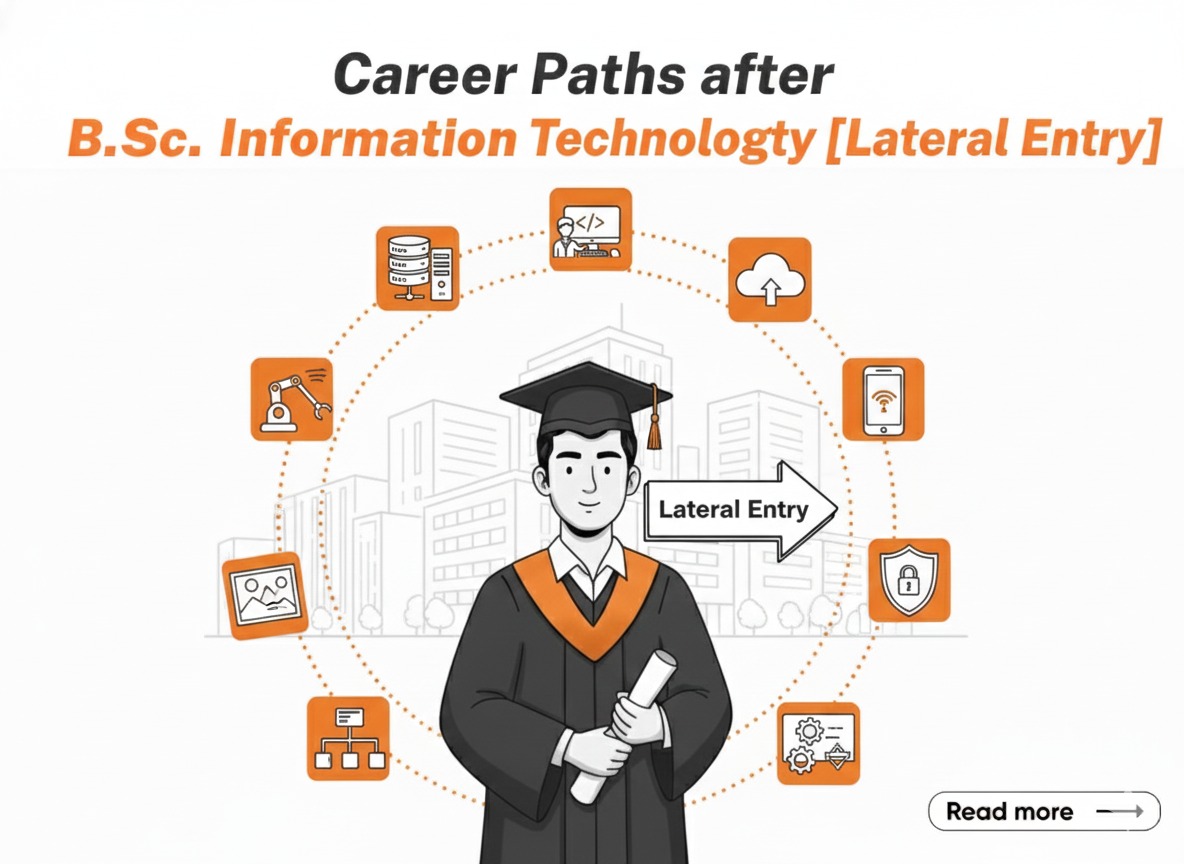
A B.Sc. Information Technology [Lateral Entry] opens up a wide range of career opportunities in the fast-growing IT sector. Graduates can pursue roles in software development, web development, networking, database management, cybersecurity, and cloud computing.
Career Paths after B.Sc. Information Technology [Lateral Entry] are-
| Career Role | Key Responsibilities |
| Software Developer | Designing, coding, testing, and maintaining software applications. |
| Web Developer | Creating and managing websites and web applications using frontend and backend tools. |
| Network Administrator | Managing and maintaining computer networks, ensuring connectivity and security. |
| Database Administrator (DBA) | Designing, managing, and securing databases, ensuring efficient data storage and access. |
| System Analyst | Analyzing system requirements, improving IT processes, and implementing solutions. |
| Cybersecurity Analyst | Monitoring and protecting IT systems from cyber threats and vulnerabilities. |
| Cloud Solutions Engineer | Managing cloud infrastructure, deployment, and services. |
| Mobile App Developer | Designing and developing applications for mobile devices |
| IT Support Engineer | Providing technical support, troubleshooting hardware/software issues. |
| Project Manager (IT) | Planning, coordinating, and managing IT projects. |
With the rapid expansion of technology and digital transformation across industries, B.Sc. Information Technology [Lateral Entry] provides the skills, knowledge, and versatility needed to build a rewarding and future-ready career in the ever-evolving IT landscape.
Top Job Roles for B.Sc. Information Technology [Lateral Entry] Graduates
Graduates of B.Sc. Information Technology [Lateral Entry] have a variety of career options in the IT and tech industry. Some of the most sought-after job roles include:
- Software Developer / Programmer
Designing, developing, and maintaining software applications.
Working with programming languages like Java, Python, C++, or C#. - Web Developer
Building and maintaining websites and web applications.
Skills in HTML, CSS, JavaScript, and backend technologies. - Network Administrator / Network Engineer
Managing and maintaining computer networks within organizations.
Ensuring security, connectivity, and smooth network operations. - Database Administrator (DBA)
Organizing, storing, and securing data in databases.
Working with SQL, Oracle, MySQL, or other database systems.
- System Analyst
Analyzing IT systems, recommending improvements, and implementing solutions.
Bridging the gap between business requirements and IT solutions. - Cybersecurity Analyst
Protecting systems and networks from cyber threats.
Conducting vulnerability assessments and implementing security measures. - Cloud Solutions Engineer / Cloud Administrator
Managing cloud infrastructure and deploying cloud-based services.
Working with platforms like AWS, Azure, or Google Cloud.
A B.Sc. Information Technology [Lateral Entry] degree opens the door to a wide array of dynamic and rewarding career opportunities.
Graduates are well-equipped to explore roles ranging from software development, network administration, and cybersecurity to data analysis, cloud computing, and IT support.
The versatility of the degree allows individuals to align their career paths with their interests, whether in technical development, system management, or emerging technologies.
Emerging Career Opportunities in AI, Data Science, and Cloud Computing
Careers in AI, data science, and cloud computing offer exciting opportunities in some of the most innovative areas of technology today.
LPU runs dedicated programmes in AI, Data Science, Cloud Computing and allied streams: for example, there’s a B.Tech in Computer Science & Engineering (Cloud Computing and GEN AI) tied up with Google Cloud.
With the growing reliance on technology across industries, these roles are in high demand and provide strong career growth, competitive compensation, and the chance to work on projects that shape the future.
Emerging Career Opportunities in AI, Data Science, and Cloud Computing are-
| Field | Key Roles |
| Artificial Intelligence (AI) | AI Engineer, Machine Learning Engineer, NLP Specialist |
| Data Science | Data Analyst, Data Scientist, Business Intelligence Analyst |
| Cloud Computing | Cloud Engineer, DevOps Engineer, Cloud Architect |
With the growing reliance on technology across industries, these roles are in high demand and provide strong career growth, competitive compensation, and the chance to work on projects that shape the future. Staying updated with the latest tools, frameworks, and trends is key for success in these dynamic fields.
AI professionals work on creating intelligent systems that can learn and adapt, data scientists analyze complex datasets to derive meaningful insights, and cloud computing specialists build scalable and secure digital infrastructures that support modern businesses.
These roles are in high demand across industries, offering strong growth prospects, competitive salaries, and opportunities to work on innovative projects that shape the future.
By staying updated with emerging tools and technologies, professionals in these fields can build rewarding and impactful careers in an ever-evolving digital landscape.
LPU has a strong placement ecosystem. Its placement record shows many offers, including roles related to AI/data, with recruiters from big companies.
Government and Public Sector Opportunities for IT Graduates
IT graduates have a wide range of opportunities in government and public sector organizations, offering stable careers and the chance to contribute to national development.
Government and Public Sector Opportunities for IT Graduates are-
| Sector/Organization | Key Roles |
| Government Ministries | IT Officer, System Administrator |
| Public Sector Banks | IT Analyst, Database Administrator |
| Defense & Security | Cybersecurity Analyst, Network Engineer |
| Research & Development Organizations | Software Developer, Data Analyst |
| E-Governance & Digital Services | IT Consultant, Project Manager |
They can work in areas such as e-governance, cybersecurity, digital infrastructure management, and IT policy implementation.
Roles in government ministries, public sector banks, defense, and research organizations involve managing IT systems, developing software solutions, maintaining networks, and ensuring data security.
With the increasing digitization of government services, IT professionals play a critical role in making public services more efficient, transparent, and accessible.
LPU has a strong track record of campus placements, especially in IT / Computer Science / allied branches. For example, many top global and Indian firms such as Microsoft, Amazon, Cognizant, TCS, Wipro, Capgemini routinely recruit LPU students — indicating a healthy industry‑academic linkage.
Because of this background and exposure, LPU graduates aren’t limited to only corporate or private‑sector jobs: their skill sets (software development, data handling, cloud, IT fundamentals etc.) are potentially useful for public sector or government‑oriented IT / e‑governance / digital‑infrastructure roles too. The training and exposure to modern technologies/industry tools can give them a competitive edge.
Entrepreneurship and Freelancing in the IT Sector
The IT sector offers abundant opportunities for entrepreneurship and freelancing, enabling professionals to leverage their technical skills to build independent careers or start innovative ventures.
IT graduates can develop software products, mobile applications, AI solutions, cloud-based services, or offer specialized consulting in areas such as cybersecurity, data analytics, and web development.
Freelancing platforms like Upwork, Fiverr, and Toptal allow IT professionals to work with global clients, manage projects independently, and earn competitive incomes while maintaining flexible schedules.
Entrepreneurship, on the other hand, empowers individuals to create startups, launch IT products or services, and scale solutions for wider markets.
Success in these paths requires not only technical expertise but also business acumen, strategic planning, problem-solving, and adaptability.
Both freelancing and entrepreneurship encourage creativity, continuous learning, and innovation, making them highly rewarding alternatives or complements to traditional employment in the IT sector.
Entrepreneurship and freelancing in the IT sector provide IT graduates with the freedom to explore innovative projects, build independent careers, and create scalable solutions.
These paths not only offer financial rewards and flexibility but also foster creativity, problem-solving, and continuous skill development.
By combining technical expertise with business acumen and adaptability, IT professionals can leverage these opportunities to achieve professional growth while contributing meaningful technological solutions to the market.
IT professionals can offer services like web development, app development, software testing, AI/ML solutions, cloud services, data analytics, cybersecurity consulting, and more. Platforms like Upwork, Fiverr, Toptal, Freelancer allow access to global clients.
| Did You Know ?
Entrepreneurs can operate globally without relocating their business. Remote teams and cloud-based tools make international collaboration seamless. |
Exploring Global Career Opportunities in Information Technology
Exploring global career opportunities in Information Technology (IT) reveals a world full of possibilities, as IT skills are in demand across almost every industry and country.
The rise of remote work, fueled by cloud computing and collaboration tools like Zoom, Slack, and Teams, allows IT professionals to work for companies anywhere in the world without relocating.
High-paying roles in software development, cloud computing, cybersecurity, data science, AI, and mobile app development are especially sought after, with emerging fields like blockchain, Web3, and sustainable technology offering new avenues for growth.
Accessing these global opportunities can be achieved through remote freelancing on platforms such as Upwork and Toptal, joining multinational companies locally, or pursuing international certifications like AWS, Azure, CISSP, and PMP.
Networking through LinkedIn, GitHub, and tech forums, building a strong portfolio, and staying updated on cutting-edge technologies are essential strategies for success.
Additionally, countries like the USA, Canada, Germany, Australia, and Singapore actively recruit skilled IT professionals through relocation programs, creating pathways for long-term international careers.
With the IT industry continuously evolving, professionals who adapt to emerging technologies, acquire globally recognized skills, and embrace remote or international opportunities can enjoy a rewarding and flexible global career.
With the rise of remote work, international projects, and high-demand specialties like AI, cybersecurity, and cloud computing, IT careers are no longer confined by geography.
By continuously upskilling, building a strong professional network, and leveraging global platforms, IT professionals can access rewarding roles, competitive compensation, and the chance to make a worldwide impact.
Ultimately, the IT field empowers individuals to shape their careers on a global scale, blending innovation, flexibility, and growth.
Conclusion
Choosing a career in Information Technology (IT) after completing a B.Sc. Information Technology [Lateral Entry] offers significant opportunities for professional growth, high earning potential, and global relevance.
The IT industry is constantly evolving, driven by advancements in areas like software development, cloud computing, cybersecurity, artificial intelligence, data science, and mobile applications.
This creates a wide range of career paths for graduates, from technical roles such as software engineer or system analyst to managerial positions like IT project manager or solutions architect.
IT as a career is appealing because it offers job stability, opportunities for continuous learning, and the flexibility to work in diverse industries or even remotely.
Moreover, the global demand for skilled IT professionals ensures that qualified graduates can access international opportunities, competitive salaries, and the ability to work on innovative projects.
In essence, a career in IT not only provides strong short-term job prospects but also long-term growth, personal development, and the chance to be part of a transformative and future-focused industry.
IT careers offer flexibility through remote work, freelancing, or entrepreneurial ventures, enabling graduates to work with companies worldwide or start their own ventures with minimal initial investment.
With high global demand for IT professionals, competitive salaries, and job security, IT provides not only immediate employment opportunities but also long-term career advancement.
Overall, IT as a career combines innovation, global relevance, financial rewards, and personal growth, making it an ideal choice for B.Sc. Information Technology [Lateral Entry] graduates seeking a dynamic and future-oriented profession.
Choosing IT as a career after B.Sc. Information Technology [Lateral Entry] not only ensures strong short-term job prospects but also offers long-term growth, global opportunities, and the ability to work in cutting-edge technology domains. It’s a career that combines innovation, flexibility, stability, and personal growth, making it one of the smartest choices for today’s graduates.
Frequently Asked Questions (FAQs)
1. What is B.Sc. Information Technology [Lateral Entry] ?
B.Sc. Information Technology [Lateral Entry] is an undergraduate degree that focuses on computer science, programming, networking, database management, web development, and IT infrastructure.
- What are the popular specializations in B.Sc. Information Technology [Lateral Entry] ?
Data Science and Analytics, Artificial Intelligence and Machine Learning, Cybersecurity, Cloud Computing, Web and Mobile App Development, Software Engineering. It prepares students for careers in software development, IT support, data management, and emerging technologies like AI and cloud computing.
3. What are the career opportunities after B.Sc. Information Technology [Lateral Entry] ?
Software Developer / Engineer, Web Developer / App Developer,Network Administrator / Cybersecurity Analyst, Data Analyst / Data Scientist
IT Support / System Administrator, Cloud Engineer / DevOps Engineer.
4. How are placements for B.Sc. Information Technology [Lateral Entry] graduates?
Placement opportunities are generally good, especially in reputed colleges and universities.
Companies hiring include TCS, Infosys, Wipro, Cognizant, IBM, Accenture, Capgemini, Microsoft, Amazon, and startups.
Students with strong programming, networking, and emerging tech skills have higher chances of securing top roles.
5. Is B.Sc. Information Technology [Lateral Entry] better than B.Tech in IT/Computer Science?
B.Tech is more engineering-focused with in-depth technical and hardware knowledge, while B.Sc. Information Technology [Lateral Entry] is more software- and application-oriented.
B.Sc. Information Technology [Lateral Entry] graduates can enter IT jobs faster and often focus on practical skills, certifications, and entrepreneurship.