
- Why Choose M.A. Punjabi as Your Postgraduate Path?
- What Does the Study of Punjabi Language and Literature Involve?
- Career Options after M.A. Punjabi – A Broad Overview
- How to Build a Career in Teaching and Academics?
- Roles in Publishing, Editing, and Translating Punjabi Texts
- Opportunities in Creative Writing, Journalism, and Broadcasting
- Government and Cultural Department Roles for Punjabi Graduates
- How to Prepare for Public Service and Competitive Exams with Punjabi?
- Research and Doctoral Opportunities after M.A. Punjabi
- Exploring Entrepreneurship in Literature and Media Fields
- Conclusion
- Frequently Asked Questions (FAQs)
Why Choose M.A. Punjabi as Your Postgraduate Path?
The M.A. Punjabi programme is a meaningful and career-focused postgraduate Punjabi course designed for students who wish to explore the depth of Punjabi language, literature, culture, and heritage. In an era where regional languages are gaining global recognition, this degree opens doors to multiple academic, creative, and professional pathways. The M.A. Punjabi career scope is not only limited to teaching or academia—graduates can contribute in areas like linguistic research, media, translation, literature development, publishing, cultural organizations, and public administration.
One of the key benefits of studying Punjabi at the postgraduate level is the ability to preserve and promote a language that carries rich historical significance and an extensive literary tradition. The course enhances critical appreciation, writing skills, cultural awareness, and communication abilities—qualities that are highly valued across educational institutions, media houses, publishing agencies, and government sectors. For individuals passionate about language and culture, pursuing M.A. Punjabi is not just an academic decision, but a step towards shaping a meaningful and impactful career.
| Did you know?
Punjabi is one of the fastest-growing regional languages online, especially on YouTube, Instagram, and podcast platforms. This growth has opened doors for Punjabi content creation careers, allowing graduates to showcase culture, literature, and storytelling to global audiences in creative ways. |
What Does the Study of Punjabi Language and Literature Involve?
The study of Punjabi language and literature goes far beyond reading poetry or understanding grammar. The Punjabi literature syllabus in postgraduate studies is designed to help students explore classical, medieval, and modern literary works while analyzing their cultural, social, and philosophical contexts. Students engage with the writings of prominent poets, novelists, dramatists, and critics who have shaped Punjabi literary history.
In addition to literature, the programme also places strong focus on Punjabi linguistics, which includes understanding the evolution of the Punjabi language, its phonetics, syntax, semantics, and dialectal variations. This linguistic study equips learners with the ability to research language patterns, contribute to language preservation efforts, and pursue careers in translation, interpretation, and comparative literature.
Furthermore, students dive into Punjabi cultural studies, where they gain insights into Punjab’s traditions, folklore, performing arts, heritage, and societal values. This helps them understand how language and culture influence identity and community life. Through a blend of literature, language science, and cultural exploration, the M.A. Punjabi degree nurtures scholars who can critically analyze, preserve, and contribute to the rich legacy of Punjabi language and culture.
| Did you know?
Many UPSC and State PSC aspirants choose Punjabi as their optional subject because of its rich literature, scoring potential, and availability of resources. Students with strong command over Punjabi grammar and poetry often perform exceptionally well in civil services preparation. |
Career Options after M.A. Punjabi – A Broad Overview
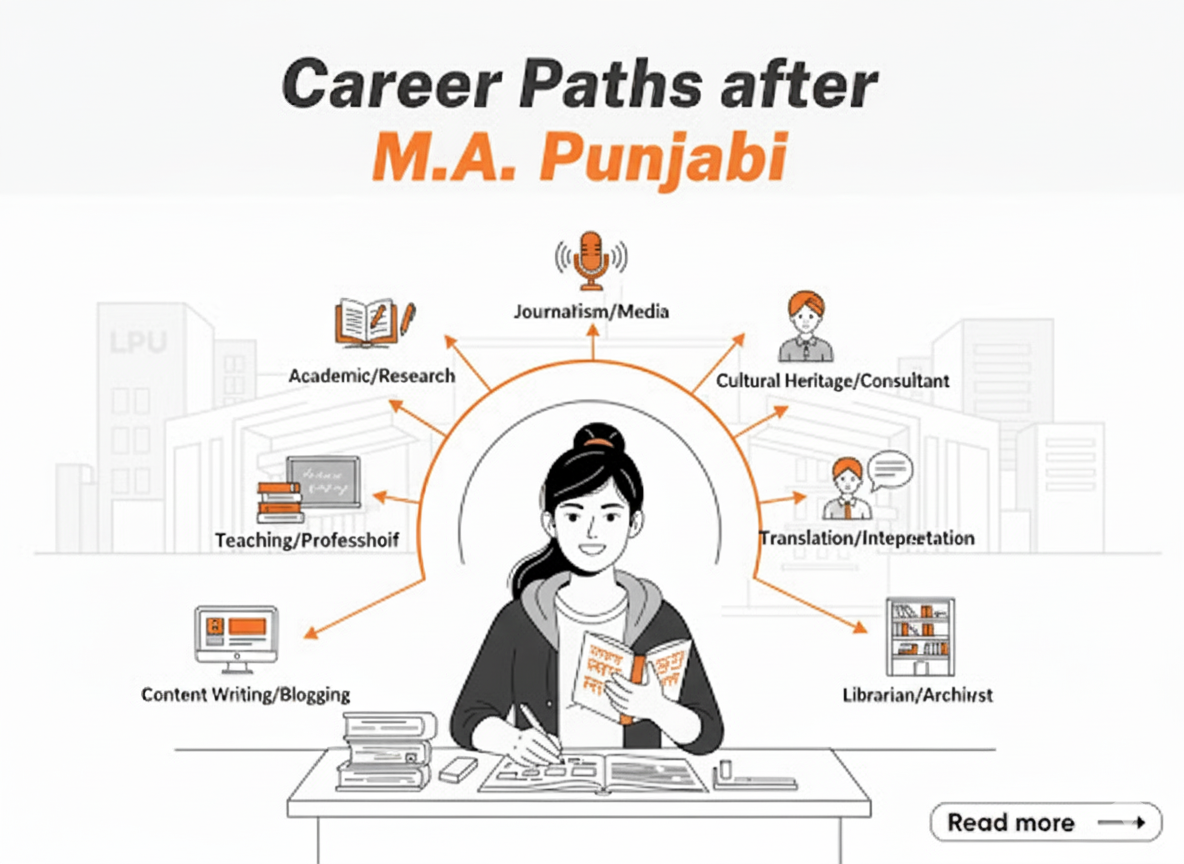
The career opportunities after M.A. Punjabi are diverse and meaningful, allowing graduates to contribute to education, literature, media, cultural research, and public services. The scope of M.A. Punjabi is not limited to lectureships alone—students can explore roles in academic institutions, publishing houses, government organizations, private companies, and cultural institutions. With strong communication, analytical thinking, and cultural understanding, graduates are well-prepared for both traditional and modern career environments.
There are various Punjabi degree jobs available for postgraduates, ranging from language-based roles to creative and administrative positions. For those inclined toward academic careers, teaching at schools, colleges, or coaching centers is a popular option. Meanwhile, individuals with an interest in writing, journalism, or media can pursue work as content creators, reporters, editors, proofreaders, translators, or scriptwriters. Many graduates also move into research and cultural preservation, working with archives, museums, and literary organizations.
Overall, an M.A. Punjabi degree helps students build careers that promote language, heritage, communication, and community development. Whether one aims for a professional position, creative contribution, or further academic specialization, this degree provides a solid foundation for a fulfilling and impactful future.
| Did you know?
Punjabi graduates are increasingly exploring cultural entrepreneurship, creating startups focused on folk literature, traditional art, theater, and storytelling. These ventures do not just preserve heritage but also turn cultural knowledge into a sustainable income source. |
How to Build a Career in Teaching and Academics?
For many students, building a career in education is one of the most rewarding outcomes of pursuing M.A. Punjabi. Teaching is not only a profession but also a service that allows graduates to share knowledge, preserve cultural heritage, and inspire younger generations. There is strong demand for qualified Punjabi educators across schools, colleges, universities, and cultural education centers, making this field both stable and respected.
There are numerous Punjabi lecturer jobs available in government as well as private institutions. Schools often require teachers who can confidently teach Punjabi language and literature, while higher education institutions look for subject experts who can guide students through complex literary theories, research methodologies, and linguistic analysis.
To begin a teaching career after M.A. Punjabi, candidates can consider the following pathways:
- Teaching in Schools:
- Many schools look for postgraduate Punjabi teachers to teach middle, secondary, and senior secondary levels.
- A B.Ed. degree is often required to become eligible for permanent teaching positions in most educational boards.
- Becoming a College or University Lecturer:
- For students aiming to teach at a higher level, clearing the UGC-NET exam is essential.
- Once qualified, candidates become eligible to apply for positions such as assistant professor Punjabi in colleges and universities.
- This pathway also provides the opportunity to pursue Ph.D. research, publish academic papers, and take part in conferences.
- Becoming a Research Scholar or Cultural Academic:
- Students with a deeper interest in Punjabi linguistics, folklore, or regional studies can join research institutes or cultural organizations.
- These roles involve writing research papers, documenting language history, studying dialects, and contributing to cultural preservation projects.
Skills That Strengthen an Academic Career
- Strong command over Punjabi grammar and literature
- Ability to explain complex concepts clearly
- Interest in research, writing, and analysis
- Effective classroom communication and leadership
Career Growth and Benefits
- Opportunity to inspire and educate future generations
- Stable employment and government job prospects
- Respect and recognition in academic and cultural circles
- Ability to contribute to cultural preservation and literary development
Overall, pursuing a career in teaching and academics after M.A. Punjabi allows individuals to make an impact that goes beyond textbooks. It is a profession rooted in knowledge, identity, and cultural pride — offering both personal fulfillment and professional advancement.
| Did you know?
There is a rising demand for Punjabi translators, editors, and scriptwriters in digital media, OTT platforms, and audiobook publishing. As the entertainment industry expands regionally, Punjabi language professionals are becoming essential contributors to film and media projects. |
Roles in Publishing, Editing, and Translating Punjabi Texts
Beyond teaching and academia, the field of publishing and translation offers meaningful and creative professional avenues for M.A. Punjabi graduates. With the growing demand for regional language content in print media, digital platforms, literature, and government communication, there are many promising Punjabi translator jobs and editorial positions available.
Professionals in this field may work with newspapers, magazines, book publishers, digital content platforms, research organizations, cultural academies, government departments, and private media houses. Their role involves ensuring that Punjabi language publications are accurate, culturally relevant, and easy to understand.
Editing and publishing in Punjabi require strong command over grammar, spelling, literary style, and cultural context. Editors are responsible for reviewing manuscripts, improving language flow, and maintaining consistency in tone and structure. Proofreading is another related role where the focus is on correcting errors and ensuring quality standards.
For those with a passion for bringing literature across language boundaries, literary translation careers are particularly fulfilling. Translators convert Punjabi literary works into other languages and vice versa, making stories, poetry, and cultural knowledge accessible to broader audiences. This field has gained importance as more institutions and readers across the world are showing interest in regional literature.
Common Job Roles in This Domain
- Translator (Books, Media, Corporate, or Government Documents)
- Editor or Sub-Editor in Media Organizations
- Proofreader for Publishing Houses
- Content Writer / Language Specialist
- Script Editor for Films, Radio, and Theatre Productions
- Cultural Documentation and Archiving Expert
Skills That Strengthen Success in Publishing & Translation
- Excellent language command and vocabulary
- Understanding of cultural and literary context
- Attention to detail and clarity in expression
- Ability to adapt tone and meaning accurately while translating
Working in publishing and translation allows individuals to contribute directly to the preservation, expansion, and modernization of Punjabi literary culture, ensuring that stories, knowledge, and history continue to reach new readers and future generations.
| Did you know?
Many universities and cultural organizations support Punjabi publishing startups, where young writers publish poetry collections, novels, research journals, and digital magazines. This movement is helping revive reading culture among youth and encouraging fresh literary voices. |
Opportunities in Creative Writing, Journalism, and Broadcasting
For students who enjoy expression, storytelling, and communication, careers in the media and literary field offer exciting and dynamic work environments. The rise of regional language media channels, digital platforms, and local readership communities has increased the demand for professionals skilled in Punjabi journalism, content creation, and literary writing.
Creative writing in Punjabi provides opportunities to write poetry, short stories, novels, blogs, and scripts for theatre, films, and OTT platforms. With the growing popularity of Punjabi literature and entertainment, writers can contribute to magazines, literary journals, online blogs, television serials, and web content. Many authors also choose to publish their own books or collaborate with publishing houses.
In the field of journalism, graduates can work as reporters, news writers, content editors, anchors, or correspondents. There are numerous Punjabi daily newspapers, regional TV channels, radio stations, and digital news portals that actively hire language specialists. Strong communication skills and cultural awareness help journalists present accurate and relatable stories to the audience.
The scope also extends to media and broadcasting careers, where individuals can work as radio presenters, TV hosts, news anchors, voice artists, or scriptwriters for entertainment and educational programmes. Broadcasting roles allow graduates to reach diverse audiences while representing Punjabi identity on a larger platform.
Career Roles in This Field
- News Reporter / Correspondent- News reporters collect information, research stories, conduct interviews, and present news in a clear and engaging manner. They work for newspapers, television channels, radio networks, and online news platforms.
- Radio Jockey (RJ) or TV Anchor- RJs and anchors host radio or television programmes, interact with audiences, conduct interviews, and present information in an appealing and lively style. Confidence, clear voice, and strong communication skills are key.
- Scriptwriter for Television, Theatre, or Web Content- Scriptwriters develop scripts for dramas, films, serials, and digital content. This role requires creativity, language flair, and the ability to portray characters and emotions authentically.
- Feature Writer or Columnist –Feature writers and columnists contribute opinion articles, reviews, cultural analyses, and lifestyle stories for print or online publications. They specialize in writing thought-provoking and expressive content.
- Author or Poet- Those with literary talent can publish poetry, novels, short stories, or anthologies. Authors may work independently or with publishers, contributing to Punjabi literature and cultural heritage.
- Content Creator for Digital Platforms- Digital creators produce blogs, social media posts, video scripts, and online storytelling content for platforms like YouTube, Instagram, blogs, and educational channels. This field allows wide audience reach.
- Media Researcher / Programme Planner- Researchers study audience interests, cultural trends, and media patterns to help design radio shows, TV programmes, documentaries, and cultural events. Their work supports content planning and production strategies.
Careers in creative writing, journalism, and broadcasting allow graduates to use their voice, perspective, and cultural understanding to inform, inspire, and influence society. These roles celebrate the beauty of the Punjabi language and ensure its presence in contemporary media and cultural spaces.
Government and Cultural Department Roles for Punjabi Graduates
For students seeking stable and respected career paths, various government jobs after M.A. Punjabi are available in educational departments, administrative services, language promotion bodies, and cultural institutions. Government organizations actively value Punjabi language specialists for roles in documentation, communication, translation, and public outreach programmes.
One promising area is working in cultural officer roles, where graduates contribute to promoting Punjabi literature, arts, festivals, and heritage. These positions are often offered by state cultural academies, tourism departments, heritage conservation boards, and literary councils. Cultural officers assist in planning events, preserving folk traditions, organizing exhibitions, publishing cultural works, and engaging communities in learning about their roots.
Punjabi graduates can also work in libraries, archives, museums, and historical documentation centers, where they handle manuscripts, research cultural history, and prepare educational materials. These roles are essential in the field of Punjabi heritage promotion, ensuring that language, folklore, folk music, oral storytelling, and traditional arts are preserved for future generations.
Common Government & Cultural Sector Job Opportunities
- Language Officer / Cultural Officer in Government Departments
- Punjabi Translator or Language Specialist for Public Offices
- Heritage and Museum Research Assistant
- Library and Archival Documentation Staff
- District Cultural Coordinator / programme Facilitator
- Public Relations Officer (PRO) roles requiring Punjabi communication skills
Competitive Exams Beneficial for These Roles
- State Public Service Commission Exams
- SSC and UPSC Examinations
- UGC-NET (for higher education roles)
- Exams for Government Cultural Department Recruitments
These roles allow graduates to make a meaningful contribution by strengthening cultural identity, supporting education, and safeguarding linguistic heritage. For those passionate about Punjabi history, culture, and traditions, this career path offers both purpose and professional stability.
How to Prepare for Public Service and Competitive Exams with Punjabi?
For students who aspire to serve the nation or their state through administrative and civil services roles, Punjabi can be a strong advantage. Many competitive exams allow candidates to choose Punjabi as a subject, offering opportunities to use language skills meaningfully in governance and public administration.
One key pathway is the UPSC Punjabi optional subject. Students appearing for the Civil Services Examination can select Punjabi literature as their optional paper. Since M.A. Punjabi provides a deep understanding of literary texts, linguistics, and cultural context, graduates often find this subject scoring and manageable compared to technical or analytical optional subjects.
Similarly, candidates preparing for state PSC exams Punjabi can benefit greatly, as most State Public Service Commissions in the northern region conduct exams where Punjabi language knowledge is essential. Whether applying for roles in administrative services, education departments, cultural boards, or local governance, Punjabi medium written and spoken proficiency plays a significant role.
Steps for Effective Civil Services Preparation
- Understand the Exam Structure:
Familiarize yourself with UPSC or State PSC syllabi, including general studies, essay writing, interview preparation, and Punjabi literature optional (if chosen). - Strengthen Core Punjabi Concepts:
Revise literary periods, major poets and writers, language evolution, folk traditions, and criticism methods taught during the M.A. programme. - Daily Reading and Writing Practice:
Reading Punjabi newspapers and writing practice essays helps improve speed, clarity, and expression—useful for both written exams and interviews. - Use Standard Reference Texts:
Study authority-based Punjabi literature books, language theory guides, and previous years’ question papers for better direction. - Mock Exams and Group Discussions:
Practicing regularly and participating in discussions builds confidence, analytical thinking, and speaking skills needed for interviews.
Benefits of Preparing with Punjabi
- Familiar subject matter boosts scoring potential
- Enhances cultural and regional understanding needed for administrative roles
- Helps build strong communication and representation skills for public service
Choosing civil services preparation with Punjabi is not just a strategic academic decision—it reflects a commitment to represent regional identity and contribute to governance with cultural awareness and linguistic pride.
| Did you know?
The scope and future of M.A. Punjabi goes beyond teaching—graduates can work in journalism, advertising, government cultural departments, archival research, and even tourism. With the rise of regional storytelling and cultural preservation projects, demand for Punjabi literature experts is growing consistently. |
Research and Doctoral Opportunities after M.A. Punjabi
For students who wish to extend their academic journey beyond the postgraduate level, pursuing PhD in Punjabi is an excellent pathway. A doctoral degree allows learners to specialize in a focused research area such as Punjabi poetry, prose, folklore, Sikh literature, linguistics, cultural history, or contemporary Punjabi writing. This specialization not only deepens subject expertise but also enables scholars to contribute original insights to the field of language and literature.
There are numerous research opportunities available in universities, cultural study centers, literary academies, and language promotion institutions across India and abroad. Scholars can participate in seminars, workshops, and conferences where they can present their research work, collaborate with fellow academics, and engage in scholarly discussions. Many research projects also receive funding from governmental bodies, cultural councils, and academic grant organizations, providing financial support during doctoral studies.
Pursuing higher education in Punjabi studies leads to strong professional prospects, especially in teaching, academic research, publishing, and cultural documentation. After completing a Ph.D., individuals can become lecturers, assistant professors, curriculum developers, research fellows, or cultural programme coordinators. Some scholars also work with archives, historical museums, and literary foundations to preserve manuscripts, document oral histories, and promote Punjabi heritage at regional, national, and global platforms.
Benefits of Pursuing Research After M.A. Punjabi
- Develops in-depth expertise and analytical skills
- Opens academic and university-level teaching careers
- Offers opportunities to publish books, research papers, and translations
- Contributes to safeguarding and promoting Punjabi literature and culture
In essence, research and doctoral studies empower graduates to become thought leaders and cultural ambassadors, shaping the academic and literary future of Punjabi for generations to come.
Exploring Entrepreneurship in Literature and Media Fields
In today’s evolving creative landscape, graduates with strong language and cultural understanding can build their own careers through innovative ventures. The rise of digital platforms has made Punjabi content creation one of the most promising areas for entrepreneurship. Whether it is storytelling on YouTube, creating educational content on social media, running a literary discussion podcast, or publishing original blogs and e-magazines, individuals can share their voice with wide audiences and establish strong personal brands.
Another growing area is cultural entrepreneurship, where individuals design projects or businesses that promote Punjabi art, music, literature, folk traditions, and community identity. This may involve organizing cultural festivals, launching theatre groups, curating heritage events, preserving folk songs or tales, or developing workshops that teach language and artistic practices. Entrepreneurs in this field contribute not only to cultural preservation but also to creative economic development.
Similarly, Punjabi publishing startups are emerging as important platforms that provide space to new writers, poets, and storytellers. Graduates can launch small publishing houses, self-publishing platforms, literary magazines, or digital book services that support fresh voices in Punjabi literature. These ventures help expand literary access, encourage young authors, and promote local storytelling to national and global audiences.
Popular Entrepreneurial Avenues
- Independent blogging, vlogging, and literary podcasting
- Creating online learning platforms for Punjabi language and literature
- Starting small publishing houses or digital magazines
- Organizing cultural workshops, events, or theatre groups
- Managing literary social media pages and storytelling communities
Why Entrepreneurship Works Well After M.A. Punjabi
- Strong command of language enhances content quality
- Cultural knowledge helps connect deeply with audiences
- Digital platforms minimize startup costs and maximize outreach
- The market for authentic regional content is growing rapidly
Entrepreneurship in Punjabi literature and media not only offers financial independence but also empowers graduates to preserve cultural identity and inspire new generations of language enthusiasts.
Conclusion
The scope and future of M.A. Punjabi is rich, diverse, and evolving with time. This degree not only strengthens one’s understanding of language and literature but also opens pathways to meaningful careers in education, media, publishing, cultural preservation, government services, and research. With the increasing recognition of regional languages in digital media, literature platforms, and academic spaces, the role of Punjabi scholars is more valuable than ever.
The job prospects for Punjabi graduates remain strong across both public and private sectors—whether one chooses to become a teacher, writer, translator, journalist, cultural coordinator, or researcher. Students also have opportunities to advance into doctoral studies, civil services preparation, and creative entrepreneurship, shaping careers that are both impactful and fulfilling.
In essence, M.A. Punjabi is not just a postgraduate degree; it is a pathway toward cultural contribution, literary expression, and academic growth. For individuals passionate about language, identity, and heritage, this field offers the opportunity to build a career that is professionally rewarding and personally meaningful.
Frequently Asked Questions (FAQs)
Ques 1. What is the scope of pursuing M.A. Punjabi?
The scope of this programme is broad, covering education, media, cultural organizations, government departments, and research institutions. Graduates can work as teachers, writers, translators, journalists, and cultural facilitators, depending on their interests and skill sets.
Ques 2. Which job roles are available after completing M.A. Punjabi?
Common job roles include Punjabi lecturer, school teacher, journalist, content writer, scriptwriter, translator, editor, research assistant, cultural officer, and library or archive staff. Students with strong communication skills can also work in digital media and broadcasting.
Ques 3. What is the salary range for graduates in this field?
The salary varies depending on the career path. Entry-level positions in teaching, media, or content roles may start around ₹2.5–4 LPA, while government jobs and assistant professor roles can range from ₹6–10 LPA or higher. With experience, published work, or research credentials, earnings can grow significantly.
Ques 4. Can I pursue further studies after M.A. Punjabi?
Yes, there are excellent further studies opportunities. Students can enroll in PhD in Punjabi, pursue B.Ed. for teaching jobs, prepare for UGC-NET for academic positions, or choose interdisciplinary research fields like cultural studies, linguistics, or communication studies.
Ques 5. Is M.A. Punjabi helpful for competitive exams?
Yes, Punjabi graduates can select Punjabi as an optional subject in UPSC and State PSC exams. Fluency in Punjabi is also valuable in government recruitment for language departments, cultural boards, and educational roles.